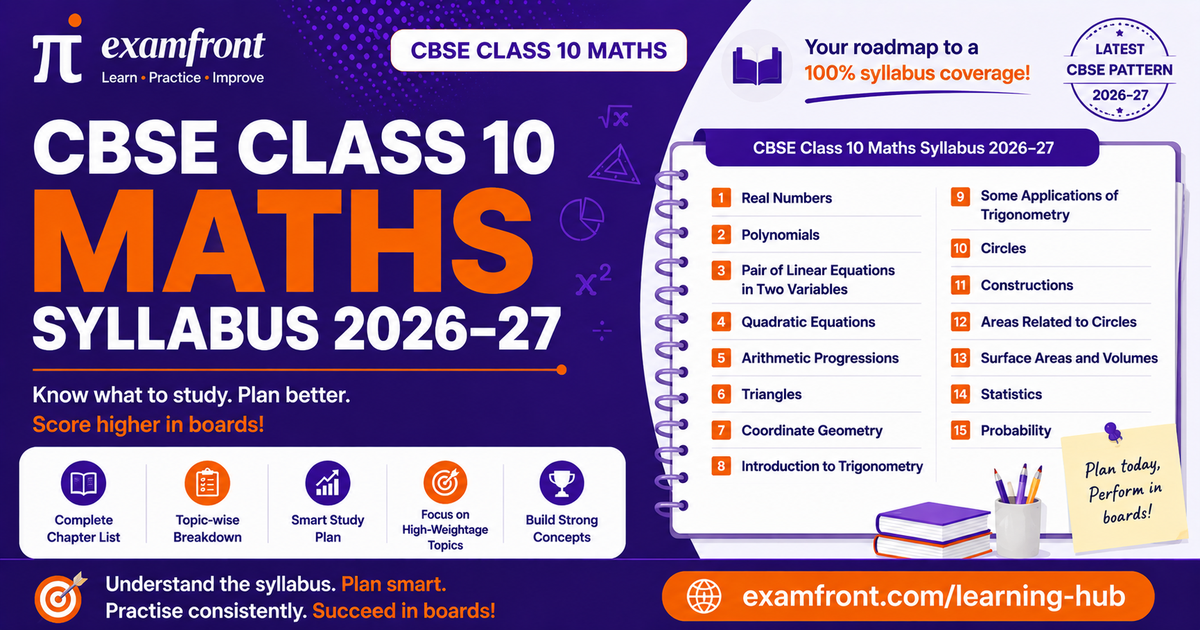
Last updated from the official CBSE Mathematics (Code 041 & 241) curriculum for Class X, 2026-27.
If you’re sitting the CBSE Class 10 Maths board exam in 2027 and wondering whether anything has changed — here’s the reassuring short answer: the syllabus structure is confirmed and stable. CBSE has released the official curriculum for the 2026-27 session, and this page lays out exactly what’s confirmed for your exam, straight from that document, so you can stop worrying and start preparing with confidence.
Is the CBSE Class 10 Maths syllabus changing for 2027?
The CBSE Class 10 Maths syllabus for 2027 keeps the same core structure students have relied on: seven units, fourteen chapters, and a 100-mark scheme (an 80-mark theory paper plus 20 marks of internal assessment). Nothing about the fundamental shape of the course has been thrown out.
What the official 2026-27 curriculum does give you is precise, confirmed detail on how the paper is built and how your internal marks are earned — and that detail is what this page focuses on. For the full unit-and-chapter map, see the main CBSE Class 10 Maths syllabus page; here we zoom into what’s specific and confirmed for the 2027 cycle.
What’s confirmed for the 2027 exam
The unit-wise marks (theory, 80 marks) are officially confirmed as:
| Unit | Marks |
|---|---|
| Number Systems | 6 |
| Algebra | 20 |
| Coordinate Geometry | 6 |
| Geometry | 15 |
| Trigonometry | 12 |
| Mensuration | 10 |
| Statistics & Probability | 11 |
| Total (Theory) | 80 |
Algebra remains the highest-weighted unit at 20 marks, with Geometry next at 15 — useful to know as you plan. For a mark-by-mark breakdown, see our unit-wise weightage guide.
The 2027 question paper design (officially confirmed)
This is the part most students don’t realise is publicly available — and it’s genuinely useful. The official 2026-27 curriculum specifies how the 80 theory marks are split by the type of thinking each question demands:
| Type of question | Marks | Approx. weightage |
|---|---|---|
| Remembering & Understanding | 43 | 54% |
| Applying | 19 | 24% |
| Analysing, Evaluating & Creating | 18 | 22% |
What this tells you is important and reassuring: more than half the paper (54%) rewards remembering and understanding — recalling facts, methods and concepts, and showing you understand them. Another 24% is straightforward application. Only about 22% asks for higher-order analysis, evaluation and creative problem-solving.
In plain terms: if you know your concepts well and can apply them, you’re already in reach of a strong score. The paper is not designed to trick you — it’s designed to reward genuine understanding.
This design tells you what kind of thinking is rewarded; for the shape of the paper itself — how many questions, how they’re split across Sections A to E, and how long you get — see the CBSE Class 10 Maths exam pattern guide.
How your 20 internal marks are earned
The other 20 marks of your final 100 come from internal assessment, conducted by your school through the year. The official 2026-27 scheme breaks these down as:
- Pen-Paper Test and Multiple Assessment — 10 marks
- Portfolio — 5 marks
- Lab Practical (activities from the prescribed books) — 5 marks
These are among the most achievable marks in the whole course, because they’re earned steadily across the year rather than in one three-hour exam. Treat them seriously from the start — they count exactly as much as any theory mark.
What’s changed, and what to do now
The 2026-27 Mathematics curriculum has been redesigned at the Secondary stage as part of CBSE’s broader curriculum refresh — but for you as a Class 10 student, the practical structure above is what matters, and it’s stable and confirmed. There’s no dramatic syllabus cut to panic about; the smart move is simply to prepare against the confirmed design.
Here’s how to use what’s on this page:
Prepare for where the marks are. With 54% of the paper rewarding remembering and understanding, building rock-solid concept clarity is the highest-return thing you can do.
Don’t neglect the 20 internal marks. Portfolio and lab work are gettable marks that students routinely leave on the table.
Practise applying, not just reading. The 24% “applying” and 22% “higher-order” portions are won through solving varied questions, not re-reading notes.
Turn the weightage into a timetable. Algebra at 20 marks and Geometry at 15 should get the biggest share of your week — our Class 10 Maths study plan shows one way to lay that out across the year.
This is exactly where a personalised approach pays off. examfront takes this confirmed 2027 structure and builds a study plan around your strong and weak areas — so your preparation is aimed precisely at how this paper is actually marked. Start preparing with examfront and turn this confirmed syllabus into your plan.
Download the 2-page summary (PDF) — the confirmed unit weightage, paper design and internal-assessment split on one sheet you can keep beside your desk.
Frequently asked questions
Has the CBSE Class 10 Maths syllabus changed for 2027? The core structure — seven units, fourteen chapters, and the 80+20 mark scheme — is confirmed and stable in the official 2026-27 curriculum. The curriculum was redesigned at the Secondary stage, but the practical exam structure for Class 10 remains as shown above.
What is the question paper pattern for Class 10 Maths 2027? Per the official 2026-27 design, the 80-mark theory paper is weighted 54% to Remembering and Understanding, 24% to Applying, and 22% to Analysing, Evaluating and Creating.
How many marks is internal assessment in Class 10 Maths 2027? 20 marks — made up of a Pen-Paper Test and Multiple Assessment (10), Portfolio (5), and Lab Practical (5).
Where can I find the official 2027 syllabus? This page reflects the official CBSE Mathematics (Code 041 & 241) curriculum for Class X, 2026-27. Always confirm against the latest document on the official CBSE academic website for any updates.
Ready to prepare for exactly how the 2027 paper is marked? Start with examfront →