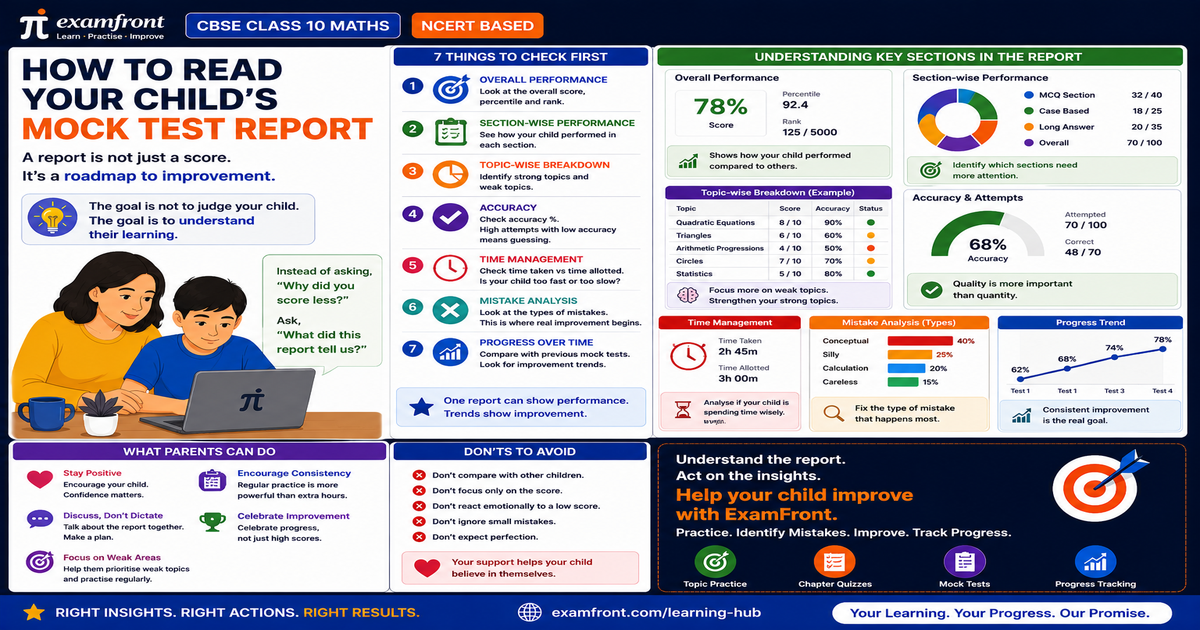
A mock test score is only the headline — the real value is in what the report tells you about how to help. Here’s how to read it well.
When your child brings home a mock test report, it’s tempting to look straight at the number and react to that. But a single score tells you very little on its own — and reacting to it (relief or worry) misses the point of a mock entirely. A mock test’s real value is as a diagnostic: it shows what’s working, what isn’t, and exactly what to do next. This guide helps you read any mock report the useful way, so you can support your child constructively.
Look past the score
The total is just the headline. Two children can score the same and need completely different help — one lost marks to shaky concepts, another to careless slips on maths they actually knew. So the first shift is simple: treat the score as a starting point, not the story. The useful questions are where the marks were lost and why.
And crucially, a mock happens while there’s still time to act. That reframes a low score entirely — it’s not a verdict on your child, it’s a map of what to work on before the real exam. A disappointing mock that’s used well is worth far more than a flattering one that’s ignored.
What actually matters in the report
If the report gives any breakdown, that’s where the value is. Look for:
- Which topics were weak — the chapters or areas where marks were lost point straight to what needs more work.
- What kinds of mistakes were made — this is the most useful signal of all (more below).
- The trend over time — is your child improving across mocks? Direction matters more than any single result.
If the report only gives a total, you can still get the breakdown by looking through the marked paper together — where were the marks lost, and why?
Where CBSE and NCERT fit into the report
Most mock reports are written in vocabulary that comes straight from the syllabus, and it helps to know what the labels mean before you try to read them.
The topic names are NCERT chapters. Class 10 Maths is fourteen chapters — Real Numbers through Probability — and a well-built report names the weak areas using those chapter names. So “weak in Arithmetic Progressions” is not a vague judgement; it points at one specific chapter of the NCERT textbook your child already owns, with its own exercises to work through. Our chapter list shows all fourteen and what each covers, and our guide on studying from NCERT explains how to actually work a weak chapter rather than just reread it.
The section names are CBSE’s. The board paper is 38 questions, 80 marks, three hours, in five sections: A (20 one-mark questions), B (5 two-mark), C (6 three-mark), D (4 five-mark) and E (3 four-mark case studies). A report that says “Section D” means the five-mark long answers, where a single unfinished question costs more than five one-markers. If the report gives you a section breakdown, our guide to the exam pattern and the one on question types tell you what is actually being tested in each.
CBSE sets the marks by unit, not by chapter. The seven units carry Algebra 20, Geometry 15, Trigonometry 12, Statistics and Probability 11, Mensuration 10, Number Systems 6 and Coordinate Geometry 6 — 80 in total. That matters when you decide what to act on first: a weak chapter inside a 20-mark unit deserves attention before an equally weak chapter inside a 6-mark one. The unit-wise weightage guide has the full table. One caution while you’re reading: chapter-level percentages are not official. CBSE publishes weightage by unit, so any per-chapter figure on a report — or on a list circulating online — is somebody’s estimate.
Check the total, too. A board-pattern mock is out of 80. Plenty of coaching mocks are out of 100, and a few mix marks and question counts on the same page. Before you read anything into a percentage, confirm what it is a percentage of.
The most useful lens: what kind of mistake?
Here’s the insight that changes how you read any report. When a mark is lost, the reason matters enormously — and reasons fall into recognisable types:
- Concept — didn’t understand the topic
- Method — wrong approach
- Calculation — a careless arithmetic slip
- Question reading — misread what was asked
- Time management — ran out of time
- Presentation — right idea, unclear working
Each of these needs a completely different response. A concept gap means going back and relearning; a calculation habit means slowing down and checking; a timing issue means practising under the clock. Lumping them together as “got it wrong” hides the fix. Our guide on analysing mistakes explains these types in full — reading a report through this lens tells you and your child precisely what to work on.
How to respond — constructively
How you talk about the report matters as much as what’s in it:
- Stay calm, whatever the score. Your composure sets the tone.
- Acknowledge the effort, then look forward: “what does this show us to work on?”
- Focus on the next step, not the number — one specific thing to improve is motivating; a bad grade alone is discouraging.
- Avoid comparison and blame — they reliably backfire.
The message you want your child to take away is that a mock is feedback, not judgement — and feedback is how you get better. (Our guide to supporting your child has more on this.)
Turning the report into a plan
A report is only useful if it changes what happens next. Once you know the weak topics and mistake types, they become the focus of the coming weeks’ revision — slotting straight into your child’s study plan.
This is where examfront helps both of you: it tracks your child’s practice, shows which concepts are weak and what kinds of mistakes recur, and turns that into a clear focus for what to work on next — so the insight from a mock report becomes an ongoing, visible picture of progress rather than a one-off snapshot. See your child’s progress with examfront and support them with clarity, not guesswork.
Download the 2-page summary (PDF) — the report-reading checklist, the six mistake types and the CBSE section map on one printable sheet.
Frequently asked questions
How should I interpret my child’s maths mock test score? Look past the single number. A score tells you where they are today; what matters more is which topics and which types of mistakes cost the marks, and whether they’re improving over time. Focus on the pattern, not the number.
My child got a low mock score. Should I be worried? Not necessarily — a mock is meant to reveal weak areas while there’s still time to fix them. Treat a low score as useful information about what to work on, not a verdict. Look at which mistakes were made and respond to those.
What’s more useful than the total score? The breakdown — which topics were weak, and what kind of mistakes were made (concept, method, calculation, reading, timing, presentation). That tells you and your child exactly what to work on next.
How should I talk to my child about a disappointing report? Stay calm and focus on the next step, not the number. Acknowledge the effort, look together at what the report shows needs work, and frame it as useful information. Avoid comparison and blame, which discourage rather than help.
Do the topics on my child’s mock test report match the NCERT and CBSE syllabus? They should. The topic names on a good report are the NCERT Class 10 Maths chapters — fourteen of them, grouped into CBSE’s seven units — and the section names match the CBSE paper’s Sections A to E. Check the total too: a board-pattern mock is out of 80 marks over 38 questions in three hours, while some coaching mocks are out of 100. And note that CBSE assigns marks by unit, not by individual chapter, so any chapter-level percentage printed on a report is an estimate rather than an official figure.
Turn every report into a next step. Explore examfront →