You don’t need to be good at maths to make a real difference — here’s how to support your child through Class 10 Maths in the ways that genuinely help.
If your child is preparing for Class 10 Maths, you might feel you can’t help much — especially if maths was never your strong subject. Here’s the reassuring truth: the most valuable support you can give has almost nothing to do with knowing the maths. Your role is to create the conditions in which your child can learn well — a calm environment, steady encouragement, and the right help when they need it. This guide shows you how to do exactly that, without hovering or adding pressure.
Seven ways you can support your child
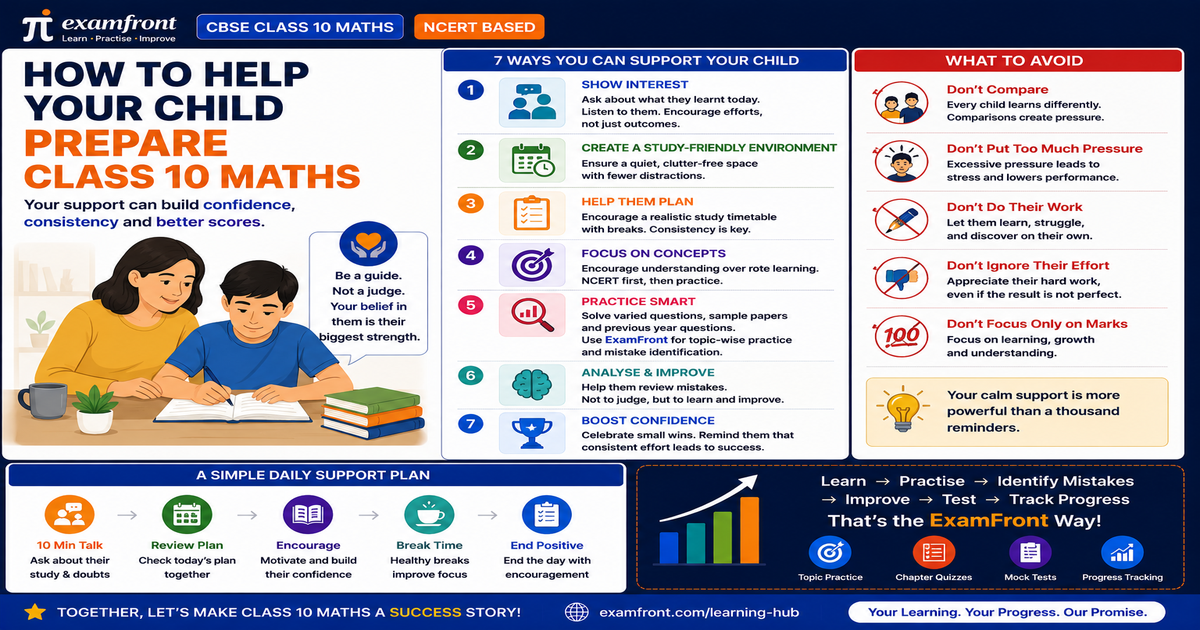
Everything below comes down to seven things, and not one of them asks you to solve an equation:
- Show interest — ask what they learnt today, and listen to the answer.
- Create a study-friendly space — quiet, uncluttered, phone away during focused work.
- Help them plan — a realistic timetable with breaks, agreed with them rather than imposed.
- Focus on concepts — understanding before rote learning; the NCERT book first, then practice.
- Practise smartly — varied questions, sample papers and previous year questions.
- Analyse and improve — review mistakes to learn from them, not to judge them.
- Boost confidence — celebrate small wins and consistent effort.
The rest of this guide is how to do each of those without hovering.
Your real job: support the conditions, not teach the subject
The subject knowledge can come from your child’s teacher, their textbook, or a learning platform. What you provide is the environment around the learning — and that turns out to matter enormously. Children study best when they feel supported rather than surveilled, encouraged rather than pressured, and calm rather than anxious. Every suggestion below is about creating that.
Build a routine, not a crackdown
Consistency helps far more than intensity. A predictable daily rhythm — a regular time and place for maths practice — removes the daily negotiation and makes studying a habit rather than a battle.
- Help your child agree on a regular study slot, and protect it from interruptions.
- Keep sessions focused and reasonable — steady daily practice beats occasional marathon sessions, because maths is built by repetition.
- Let them own the schedule as much as possible; a routine they helped set is one they’ll actually keep.
If you’d like a ready-made structure to start from, the Class 10 Maths study plan turns the syllabus into dated weeks.
Create a good study environment
You have a lot of influence here, and it’s practical:
- A quiet, well-lit space with the phone away during focused work.
- The materials to hand — notebook, past papers, whatever they’re working from — so time isn’t lost hunting for things.
- A household rhythm that respects study time — siblings and noise managed during the agreed slot.
Small environmental things remove friction, and less friction means more actual studying.
Encourage effort and progress, not just marks
This is the mindset shift that helps most. When the focus is only on marks, a low score feels like failure and motivation drops. When the focus is on effort and progress, every session and every improvement is a win.
- Praise the work and the improvement, not just the result.
- Treat mistakes as information, not failures — they show exactly what to work on next (this is genuinely how the best students improve).
- Avoid comparisons with siblings or classmates; they add pressure and rarely motivate.
If you want to help with the reviewing itself, the guide on analysing sample paper mistakes shows how to turn a marked paper into a short list of things to fix — which is a far better use of an evening than re-reading the whole chapter.
Know when to step back
Support isn’t supervision. The goal is a child who can study independently — so being available matters more than being present every minute.
- Be nearby and approachable, but let them work without hovering.
- Resist checking every problem; let them wrestle with difficulty a little — that’s where learning happens.
- Step in when they ask, or when they’re clearly stuck and frustrated — not before.
Help them get the right help
You can’t teach the maths, but you can make sure your child has good support for it — a teacher they can ask, quality practice material, or a platform that guides their preparation. One especially useful thing you can do is help them understand where they stand: our guide on reading your child’s mock test report shows you how to interpret their performance and support them constructively.
This is also where examfront can lighten your load: it guides your child’s practice, shows where they’re improving and where they’re stuck, and turns their mistakes into a clear plan — so even if you can’t help with the maths itself, your child has expert guidance, and you can see their progress. Support your child’s preparation with examfront and give them structured help alongside your encouragement.
Where NCERT and CBSE fit into your support
You don’t need to know the maths, but knowing the shape of the course gives you much better questions to ask.
NCERT sets the scope. CBSE Class 10 Maths follows the rationalised NCERT textbook — seven units and fourteen chapters, with Constructions no longer part of the syllabus. That matters practically: “which chapter are you on?” is something you can actually track, and if your child is working from an old book or an old guide, they may be spending evenings on material that has been removed. The NCERT Class 10 Maths guide lists what’s in, and how to study NCERT Maths explains why finishing the textbook exercises comes before any other practice.
CBSE sets the shape and the marks. The theory paper carries 80 marks, with 20 marks of internal assessment alongside it, and asks 38 questions across five sections. Knowing that settles two common worries: one bad long question is not a catastrophe, and internal assessment is a fifth of the final mark that quietly rewards steady classwork all year. The CBSE Class 10 Maths exam pattern has the full breakdown, and the syllabus guide shows how those marks sit across the seven units — useful when you’re deciding what a limited number of evenings should go on.
CBSE marks the method, not just the final answer. Step marks are real marks: a child who writes out the working can earn most of a question even with a slip at the end, and a child who writes only the answer can lose marks on a question they got right. So “show me your working” is a more useful thing to ask than “did you get it right?” — how CBSE Maths answers are marked explains exactly what an examiner is looking for.
None of this makes you the teacher. It just means that when your child says “I’ve finished Trigonometry”, you know what finished should look like.
A note on exam anxiety
If your child gets anxious about maths, your calm is contagious — keep your own reactions steady, normalise mistakes as part of learning, and focus together on the next small step rather than the whole looming exam. If anxiety becomes persistent or severe, it’s worth speaking with their teacher or a school counsellor; you don’t have to navigate it alone.
Download the 2-page parent summary (PDF) — the seven ways, what to avoid, and a simple daily support plan on one printable sheet.
Frequently asked questions
How can I help my child with Class 10 Maths if I’m not good at maths myself? You don’t need to know the maths. Your role is to support the conditions for learning — a calm environment, a routine, encouragement, and helping them get the right resources or help. The subject expertise can come from their teacher, their materials, or a platform.
Should I sit with my child while they study maths? Occasionally, if they want it — but the goal is independent study. Being nearby and available helps; hovering or checking every problem usually adds pressure. Let them work, and be there when they ask.
How do I motivate my child to study maths? Focus on effort and progress rather than marks, celebrate small wins, and help them see improvement over time. Pressure and comparison tend to backfire; steady encouragement works better.
My child gets anxious about maths. What can I do? Keep your own reactions calm, normalise mistakes as part of learning, and focus on the next small step rather than the whole exam. If anxiety is persistent or severe, consider speaking with their teacher or a counsellor.
Is CBSE Class 10 Maths based on the NCERT textbook? Yes. The CBSE Class 10 Maths course follows the rationalised NCERT textbook — seven units and fourteen chapters, with Constructions no longer part of the syllabus. So the NCERT book and its exercises are the syllabus, and everything else is practice on top of it. It’s worth checking that your child isn’t working from an older edition or an old guide that still includes removed material.
Support their journey with the right structure. Explore examfront →