Section Formula Class 10 Maths (Chapter 7): Formula, Midpoint & Examples
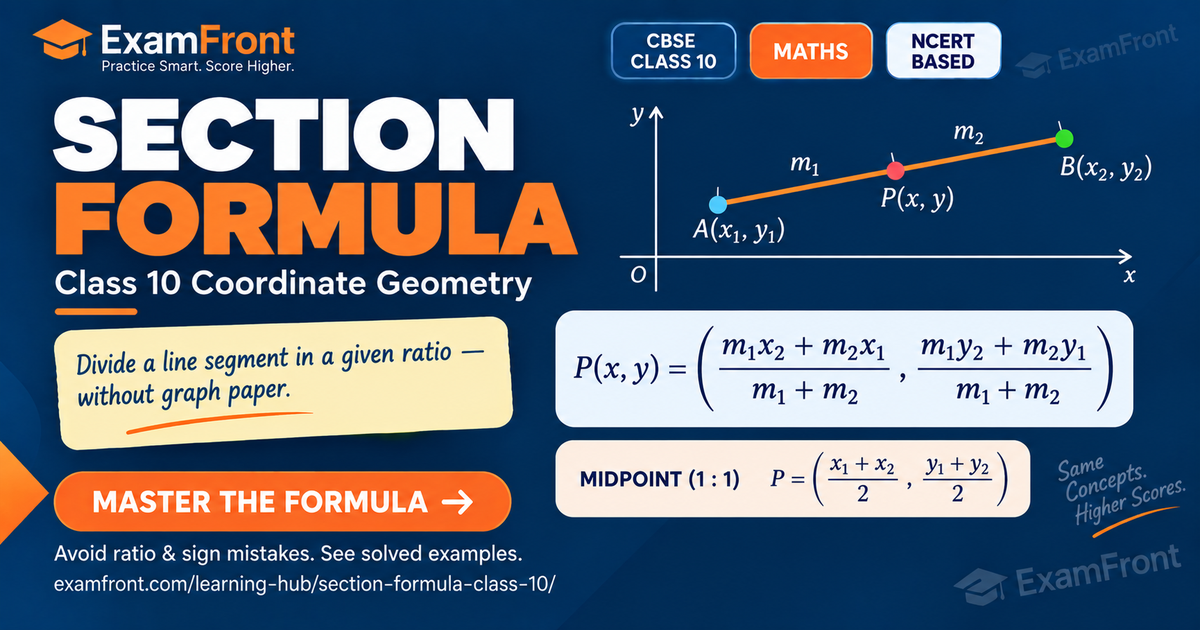
In one line: the section formula gives the coordinates of the point P(x, y) that divides the line segment joining A(x₁, y₁) and B(x₂, y₂) internally in the ratio m₁ : m₂:
P = ( (m₁x₂ + m₂x₁)/(m₁ + m₂) , (m₁y₂ + m₂y₁)/(m₁ + m₂) )
In words: multiply each far coordinate by the ratio part next to the starting point, add the matching product, and divide by the sum of the ratio parts. That single pair of numbers is the exact location of the dividing point — no graph paper needed.
Here is the classic that shows why this matters. A telephone company wants a relay tower P on the straight road from town A to town B, positioned so that its distance from B is twice its distance from A — that is, P divides AB in the ratio 1 : 2. Take A as the origin, so B is at (36, 15). Then P = ((1·36 + 2·0)/3, (1·15 + 2·0)/3) = (36/3, 15/3) = (12, 5). The section formula turned a “place it one-third of the way along” instruction into exact coordinates.
This guide (Section 7.3) covers the core you need for the CBSE board exam: the section formula and what each part means, the handy k : 1 shortcut, the midpoint formula as its special case, how to work backwards to find an unknown ratio, and a worked trisection example. The heavier problem types — parallelogram and quadrilateral vertex problems, dividing a segment into four equal parts, and external division — are flagged along the way so you know exactly where to go deeper.
🎬 Watch (60-sec Short): Can you find the midpoint in 10 seconds? ⚡
What is the section formula? (definition)
The section formula is the rule that gives the point dividing a segment in a known ratio. If P(x, y) divides the segment joining A(x₁, y₁) and B(x₂, y₂) internally (P lies between A and B) in the ratio m₁ : m₂, then:
x = (m₁x₂ + m₂x₁)/(m₁ + m₂) , y = (m₁y₂ + m₂y₁)/(m₁ + m₂)
Every symbol, in plain words:
- A(x₁, y₁) — the first point (where you start measuring the ratio).
- B(x₂, y₂) — the second point.
- m₁ : m₂ — the ratio PA : PB, i.e. how the point splits the segment. m₁ is the part next to A; m₂ is the part next to B.
- The denominator (m₁ + m₂) — the total number of equal parts the segment is cut into.
When it applies: whenever P lies between A and B (this is called internal division). The ratio parts m₁ and m₂ are positive numbers. Notice the “cross-over”: the ratio part m₁ (nearer A) multiplies x₂ (B’s coordinate), and m₂ (nearer B) multiplies x₁ (A’s coordinate). Getting that cross-over right is the whole trick.
Worked example (the formula in action)
Find the point that divides the segment joining A(4, −3) and B(8, 5) in the ratio 3 : 1 internally.
Take (x₁, y₁) = (4, −3), (x₂, y₂) = (8, 5), m₁ = 3, m₂ = 1:
x = (3·8 + 1·4)/(3 + 1) = (24 + 4)/4 = 28/4 = 7 y = (3·5 + 1·(−3))/(3 + 1) = (15 − 3)/4 = 12/4 = 3
So the required point is (7, 3). Because the ratio 3 : 1 puts P much closer to B, notice the answer sits nearer (8, 5) than (4, −3) — a quick sanity check you can do every time. Drilling this weight-and-divide rhythm until it is automatic is exactly what Topic Practice on examfront is built for.
The k : 1 form (a useful shortcut)
Any ratio m₁ : m₂ can be written as k : 1 by dividing through by m₂ (so k = m₁/m₂). Rewritten this way, the section formula becomes:
P = ( (kx₂ + x₁)/(k + 1) , (ky₂ + y₁)/(k + 1) )
Why bother? When you have to find an unknown ratio, working with a single unknown k is far easier than juggling two unknowns m₁ and m₂ — you get one equation in one variable. We use exactly this trick below.
The midpoint formula (special case)
The midpoint of a segment is the point exactly halfway along it, so it divides the segment in the ratio 1 : 1. Put m₁ = m₂ = 1 into the section formula and it collapses to a simple average:
M = ( (x₁ + x₂)/2 , (y₁ + y₂)/2 )
Meaning: for the midpoint, just average the x-coordinates and average the y-coordinates — there is no weighting because both parts of the ratio are equal.
Worked example. Find the midpoint of A(2, 3) and B(6, 7).
M = ( (2 + 6)/2 , (3 + 7)/2 ) = ( 8/2 , 10/2 ) = (4, 5)
So the midpoint is (4, 5). A neat everyday use: the centre of a circle is the midpoint of any diameter, so if you know both ends of a diameter you can find the centre instantly. Spotting when a question is secretly “just find the midpoint” saves real time in the exam — a pattern examfront’s Practice Companion helps you recognise quickly.
🎬 Watch (60-sec Short): Can you find the coordinates of the point dividing a segment in a given ratio?
How to find the ratio in which a point divides a segment
Many exam questions run the formula backwards: you are given the dividing point and asked for the ratio. The clean method is the k : 1 form.
Rule: assume the ratio is k : 1, substitute into the section formula for one coordinate (whichever is simpler), set it equal to the known value, and solve for k. Then read off the ratio as k : 1.
Worked example. In what ratio does P(1, 3) divide the segment joining A(−1, 7) and B(4, −3)?
Using the x-coordinate in the k : 1 form:
(k·4 + (−1))/(k + 1) = 1
Multiply out: 4k − 1 = k + 1, so 3k = 2, giving k = 2/3. The ratio k : 1 = (2/3) : 1 = 2 : 3.
Quick check with the y-coordinate: (k(−3) + 7)/(k + 1) with k = 2/3 gives (−2 + 7)/(5/3) = 5 × 3/5 = 3 ✓. So P divides AB in the ratio 2 : 3. A special favourite of examiners: “in what ratio does the x-axis (or y-axis) divide the segment?” — same method, using the fact that any point on the x-axis has y = 0 (and any point on the y-axis has x = 0).
Points of trisection
The points of trisection are the two points that cut a segment into three equal parts. If P and Q trisect AB, then AP = PQ = QB — so P divides AB in the ratio 1 : 2, and Q divides AB in the ratio 2 : 1.
Worked example. Find the points of trisection of the segment joining A(2, −2) and B(−7, 4).
P (ratio 1 : 2): P = ( (1·(−7) + 2·2)/(1 + 2) , (1·4 + 2·(−2))/(1 + 2) ) = ( −3/3 , 0/3 ) = (−1, 0)
Q (ratio 2 : 1): Q = ( (2·(−7) + 1·2)/(2 + 1) , (2·4 + 1·(−2))/(2 + 1) ) = ( −12/3 , 6/3 ) = (−4, 2)
So the points of trisection are (−1, 0) and (−4, 2). (Handy shortcut: Q is also the midpoint of P and B, so you can check it with the midpoint formula — ((−1 + (−7))/2, (0 + 4)/2) = (−4, 2) ✓.) These “which ratio goes with which point” set-ups are exactly where students slip, so work through the full set — with instant feedback on where your reasoning breaks — using Chapter Quizzes and Mistake Identification on examfront.
🎬 Watch (60-sec Short): Can you find the ratio in which the y-axis divides this segment? 🎯
Where this sits in the NCERT and CBSE syllabus
The section formula is Section 7.3 of NCERT Chapter 7, Coordinate Geometry — the last of the chapter’s three content sections, after 7.1 Introduction and 7.2 the distance formula.
Watch the numbering. Section 7.1 is a plain introduction with no exercise attached, so every exercise in this chapter sits one number behind its section: Section 7.2 is examined by Exercise 7.1, and Section 7.3 — this page — is examined by Exercise 7.2. Students regularly turn to “Exercise 7.3” hunting for section-formula questions and find nothing there. The whole chapter is now two exercises of ten questions each — twenty questions in total, which is a small enough set to finish properly rather than sample.
Two topics were removed, and older books still carry them. The rationalised NCERT dropped Section 7.4, Area of a Triangle, along with its exercise and the chapter’s old optional exercise. So the familiar “find k so that these three points are collinear” question — which was solved by setting a triangle’s area to zero — is off the Class 10 syllabus. Collinearity itself has not vanished: the distance version, checking whether AB + BC = AC, survives in Exercise 7.1. If your textbook or a solutions site shows Chapter 7 with four exercises, it is a pre-rationalisation edition — check it against the current CBSE syllabus before you spend an evening on deleted material.
What CBSE actually examines. Unit III, Coordinate Geometry, reads in full:
“Review: Concepts of coordinate geometry. Distance formula. Section formula (internal division).”
That parenthetical is the whole scope limit, and it doubles as a check you can run in the exam hall: at Class 10 the dividing point always lies between A and B. If a question seems to place P outside the segment, read it again — you have misread it, because external division is not examined here. The syllabus states the same expectation in its competency column, where you are asked to determine the coordinates of a point between any two given points.
What it is worth. Coordinate Geometry is its own unit, worth 6 of the 80 theory marks — the seven units run 6 + 20 + 6 + 15 + 12 + 10 + 11 = 80. Note that CBSE assigns marks by unit, never by individual chapter, so the chapter-wise percentage tables and pie charts circulating online are unofficial estimates; the unit-wise weightage guide has the official figures. Six marks is a small block, but it is one you can lock in completely, because it turns on two formulas applied carefully.
How it is asked. Exercise 7.2 is the best map of the variations, because it asks one rule five different ways: a straight application in a given ratio (Q1), the points of trisection (Q2), in what ratio the x-axis divides a segment (Q5), a missing parallelogram vertex found by using the fact that the diagonals bisect each other (Q6), and one end of a diameter given the centre and the other end (Q7) — with a divide-into-four-equal-parts question later in the same set. Only the packaging changes. Worth noticing: the ratio example worked above is Exercise 7.2 Q1 run backwards — the textbook hands you the ratio 2 : 3 and asks for the point, while the board often hands you the point and asks for the ratio. Recognising that a question is the same rule in new clothing is most of the skill, and it is exactly how CBSE frames its question types. Working straight from the textbook first is the fastest route in — see how to study NCERT maths properly and the NCERT Class 10 Maths guide.
What comes next in Chapter 7
The distance formula (Section 7.2) answered “how far apart are two points?” The section formula answers “what point sits at a given position along a segment?” Together, these two tools cover almost every Coordinate Geometry board question — from finding a missing vertex of a parallelogram (using the fact that its diagonals bisect each other) to locating the centre of a circle from a diameter.
We have kept this article focused on the core of Section 7.3 — the section formula, the k : 1 shortcut, the midpoint special case, finding an unknown ratio and a trisection example — because getting these rock-solid makes the rest of the chapter easy. For the complete method on parallelogram and quadrilateral vertex problems, dividing a segment into four equal parts and axis-intersection ratios in full, continue with the Coordinate Geometry chapter guide and work through it on examfront, where Progress Tracking shows you exactly which skills are exam-ready.
Key Takeaways
- The section formula for P dividing A(x₁, y₁)–B(x₂, y₂) internally in ratio m₁ : m₂ is P = ((m₁x₂ + m₂x₁)/(m₁ + m₂), (m₁y₂ + m₂y₁)/(m₁ + m₂)) — remember the cross-over: m₁ pairs with the far point.
- Writing the ratio as k : 1 turns “find the ratio” problems into one easy equation in k.
- The midpoint formula M = ((x₁ + x₂)/2, (y₁ + y₂)/2) is the section formula for the ratio 1 : 1.
- To find a ratio, set the section formula equal to the known coordinate and solve for k; on the x-axis use y = 0, on the y-axis use x = 0.
- Points of trisection divide a segment into three equal parts: one point uses ratio 1 : 2, the other 2 : 1.
- The syllabus limit is internal division — at Class 10 the dividing point always lies between A and B, so a point outside the segment means the question has been misread.
Quick Facts
- Section formula: P = ((m₁x₂ + m₂x₁)/(m₁ + m₂), (m₁y₂ + m₂y₁)/(m₁ + m₂)); m₁ : m₂ = PA : PB.
- k : 1 form: P = ((kx₂ + x₁)/(k + 1), (ky₂ + y₁)/(k + 1)).
- Midpoint formula: M = ((x₁ + x₂)/2, (y₁ + y₂)/2) — the ratio 1 : 1 case.
- Trisection: ratios 1 : 2 and 2 : 1; the two points cut the segment into three equal parts.
- Internal division only at Class 10 level (P lies between A and B); external division comes later.
- NCERT: Chapter 7, Section 7.3, examined by Exercise 7.2 (Section 7.2 → Exercise 7.1). Two exercises, ten questions each.
- Removed in the rationalisation: Section 7.4 Area of a Triangle, its exercise, and the old optional exercise — so area-based collinearity is out of scope.
- Worked checks: (4, −3) & (8, 5) in 3 : 1 → (7, 3); midpoint of (2, 3) & (6, 7) → (4, 5); trisection of (2, −2) & (−7, 4) → (−1, 0) and (−4, 2).
- Chapter: Coordinate Geometry (Ch. 7) · Unit: III, 6 of 80 · Class: 10 · Subject: Maths · Board: CBSE.
Common Mistakes
- Forgetting the cross-over (pairing m₁ with the wrong point). The x-coordinate is (m₁x₂ + m₂x₁)/(m₁ + m₂) — the ratio part m₁ multiplies the far point B’s coordinate, not A’s. Writing m₁x₁ + m₂x₂ is the single most common slip.
- Reversing the ratio. m₁ : m₂ means PA : PB. If the question measures the ratio from B instead, or you swap the parts, you get a different (wrong) point. Match m₁ to the point you start from.
- Confusing the section formula with the midpoint formula. The midpoint averages the coordinates; the section formula uses a weighted average. Only use the plain average when the ratio is 1 : 1.
- Sign errors with negative coordinates. With points like (−7, 4), carefully keep the minus signs: m₁x₂ = 1·(−7) = −7, not +7. A single dropped sign changes the whole answer.
- In “find the ratio” problems, using the wrong axis condition. A point on the x-axis has y = 0; a point on the y-axis has x = 0. Setting the wrong coordinate to zero (or forgetting this step) is a frequent mistake.
📄 Free download: Section Formula — 2-page summary sheet (PDF) — the formula, the midpoint case, the NCERT and CBSE scope, and a fully worked Exercise 7.2 question.
FAQ
Q. What is the section formula in Class 10 Maths? The section formula gives the coordinates of the point P(x, y) that divides the line segment joining A(x₁, y₁) and B(x₂, y₂) internally in the ratio m₁ : m₂. It is P = ((m₁x₂ + m₂x₁)/(m₁ + m₂), (m₁y₂ + m₂y₁)/(m₁ + m₂)), where m₁ : m₂ is the ratio PA : PB. For example, the point dividing (4, −3) and (8, 5) in the ratio 3 : 1 is ((3·8 + 1·4)/4, (3·5 + 1·(−3))/4) = (7, 3).
Q. What is the midpoint formula and how is it related to the section formula? The midpoint formula gives the point exactly halfway between A(x₁, y₁) and B(x₂, y₂): M = ((x₁ + x₂)/2, (y₁ + y₂)/2). It is the section formula for the special ratio 1 : 1 — when a point divides a segment equally, the weighted average becomes a plain average. For example, the midpoint of (2, 3) and (6, 7) is (4, 5).
Q. How do you find the ratio in which a point divides a line segment? Assume the ratio is k : 1 and use the section formula for one coordinate. Set it equal to the known coordinate of the dividing point and solve for k, then write the ratio as k : 1. For example, to find how (1, 3) divides (−1, 7) and (4, −3): (4k + (−1))/(k + 1) = 1 gives 4k − 1 = k + 1, so 3k = 2 and k = 2/3 — the ratio is 2 : 3.
Q. What are points of trisection? The points of trisection are the two points that divide a line segment into three equal parts. If P and Q trisect AB, then AP = PQ = QB, so P divides AB in the ratio 1 : 2 and Q divides it in the ratio 2 : 1. You find each point with the section formula. For A(2, −2) and B(−7, 4), the points of trisection are (−1, 0) and (−4, 2).
Q. Does the order of the ratio m₁ : m₂ matter in the section formula? Yes. The ratio m₁ : m₂ means PA : PB, where m₁ is measured from the first point A and m₂ from the second point B. Swapping to m₂ : m₁ gives a different point, because m₁ multiplies the far point’s coordinate (x₂) while m₂ multiplies the near point’s coordinate (x₁). Always match m₁ to the point you measure the ratio from.
Q. Are area of a triangle and external division still part of the NCERT and CBSE Class 10 section formula syllabus? No — both are outside the current Class 10 course. The rationalised NCERT removed Section 7.4, Area of a Triangle, along with its exercise and the chapter’s old optional exercise, so Chapter 7 is now two exercises of ten questions each: Exercise 7.1 on the distance formula and Exercise 7.2 on the section formula. The CBSE syllabus scopes the unit to “Review: Concepts of coordinate geometry. Distance formula. Section formula (internal division)”, and that “(internal division)” means the dividing point always lies between the two given points. If your textbook or a solutions site shows Chapter 7 with four exercises, it is a pre-rationalisation edition.
Related Concepts
- Coordinate Geometry — Chapter Guide (Class 10): the full chapter roadmap, including harder section-formula problems and quadrilateral vertices.
- Distance Formula (Class 10): the Section 7.2 tool for how far apart two points are — the natural partner to the section formula.
- What Is Coordinate Geometry? (Class 10): the Section 7.1 foundations — plane, axes, abscissa, ordinate and quadrants — that this article builds on.
- Class 10 Maths — All Formulas: the quick-reference sheet where the section and midpoint formulas live.
Ready to make the section formula automatic? Practise it on examfront’s Topic Practice, and let Mistake Identification and Progress Tracking show you exactly where a cross-over or sign slip creeps in. Start on examfront →