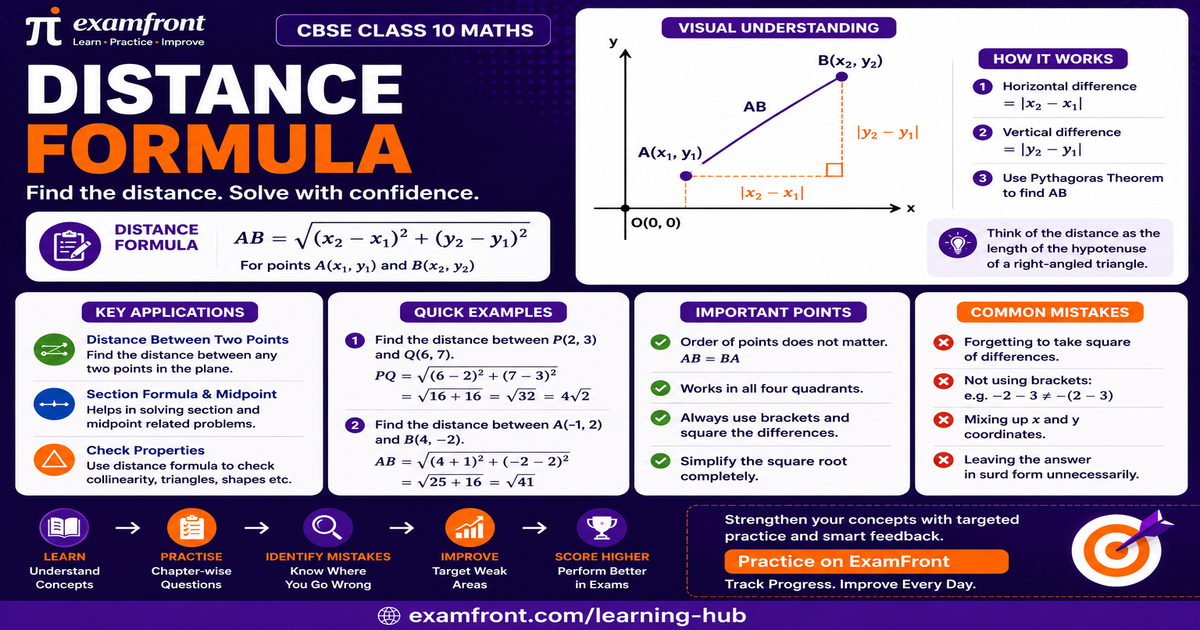
Distance Formula Class 10 Maths (Chapter 7): Formula, Steps & Examples
In one line: the distance formula gives the straight-line distance between two points P(x₁, y₁) and Q(x₂, y₂) on the coordinate plane:
PQ = √[(x₂ − x₁)² + (y₂ − y₁)²]
In words: subtract the x-coordinates, subtract the y-coordinates, square both differences, add them, and take the positive square root. That single result is the exact length of the segment joining the two points — no ruler needed.
Here is the quick classic that shows why this matters. A town B is 36 km east and 15 km north of town A. How far apart are they in a straight line? Treat A as the origin, so B is at (36, 15). Then AB = √(36² + 15²) = √(1296 + 225) = √1521 = 39 km. The distance formula turned a map into a number — and that is exactly what Chapter 7 asks you to do again and again.
This guide (Section 7.2) covers the core you need for the CBSE board exam: the formula and what each part means, why it is really the Pythagoras theorem in disguise, the shortcut for the distance from the origin, distances along an axis, and a worked collinearity check. The heavier problem types — classifying squares and rhombuses, equidistant-point relations and full timed practice — are flagged along the way so you know exactly where to go deeper.
🎬 Watch (60-sec Short): Can you find the distance between two points without a calculator?
What is the distance formula? (definition)
The distance formula is the rule that gives the distance between any two points whose coordinates are known. For points P(x₁, y₁) and Q(x₂, y₂):
PQ = √[(x₂ − x₁)² + (y₂ − y₁)²]
Every symbol, in plain words:
- x₁, y₁ — the coordinates of the first point P.
- x₂, y₂ — the coordinates of the second point Q.
- (x₂ − x₁) — the horizontal gap between the points (difference of the x-coordinates).
- (y₂ − y₁) — the vertical gap between the points (difference of the y-coordinates).
- The square root — turns the two gaps into one straight-line distance.
When it applies: any two points on the coordinate plane — in the same quadrant, in different quadrants, or on the axes. Distance is never negative, so you always keep only the positive square root.
A useful safety net: because each difference is squared, the order of the points does not matter. (x₂ − x₁)² equals (x₁ − x₂)², so PQ = QP — you can subtract in either direction and still land on the same answer.
Worked example (the formula in action)
Find the distance between A(1, 2) and B(4, 6).
Take (x₁, y₁) = (1, 2) and (x₂, y₂) = (4, 6):
AB = √[(4 − 1)² + (6 − 2)²] = √[3² + 4²] = √(9 + 16) = √25 = 5 units
So A and B are exactly 5 units apart. (This is the famous 3–4–5 right triangle hiding inside the coordinate plane.) Notice the three-step rhythm you will repeat every time: find the gaps → square and add → square-root. Drilling that rhythm until it is automatic is exactly what Topic Practice on examfront is built for.
Why the distance formula is really the Pythagoras theorem
The formula is not something to memorise blindly — it is the Pythagoras theorem written in coordinates. Here is the idea in one picture.
Take two points P(x₁, y₁) and Q(x₂, y₂). Drop a horizontal line from P and a vertical line from Q so they meet at a right angle at a corner point T. Now you have a right-angled triangle PTQ:
- the horizontal side PT has length (x₂ − x₁),
- the vertical side QT has length (y₂ − y₁),
- and the hypotenuse PQ is the distance you want.
By the Pythagoras theorem, PQ² = PT² + QT² = (x₂ − x₁)² + (y₂ − y₁)². Taking the positive square root gives the distance formula. That is the whole derivation — if you can see the right triangle, you can rebuild the formula any time you forget it. (If the right-triangle side of this feels shaky, a quick refresh of the Pythagoras theorem in the Triangles chapter makes the distance formula click instantly.)
Distance of a point from the origin
A very common exam sub-case is the distance of a point from the origin O(0, 0). Put (x₂, y₂) = (0, 0) into the formula and it collapses to a shorter rule:
OP = √(x² + y²)
Meaning: for a point P(x, y), just square both coordinates, add, and take the square root — there is nothing to subtract because the origin’s coordinates are 0.
Worked example. Find the distance of P(8, 15) from the origin.
OP = √(8² + 15²) = √(64 + 225) = √289 = 17 units
So P(8, 15) is 17 units from the origin. (This is the same shortcut that solved the town puzzle: (36, 15) sits 39 units from the origin.) Recognising when a question is secretly “distance from the origin” saves you time in the exam — a pattern examfront’s Practice Companion helps you spot quickly.
Distance between points on the same axis (quick cases)
When both points share a line, the formula simplifies to a plain subtraction:
- Both on (or parallel to) the x-axis — same y-coordinate. The distance is just the difference of the x-coordinates: |x₂ − x₁|. Example: the distance between (2, 5) and (9, 5) is |9 − 2| = 7 units.
- Both on (or parallel to) the y-axis — same x-coordinate. The distance is the difference of the y-coordinates: |y₂ − y₁|. Example: the distance between (2, 3) and (2, 9) is |9 − 3| = 6 units.
These are not separate formulas to memorise — they are what the distance formula becomes when one of the differences is 0. Spotting them stops you from over-calculating a one-step answer.
🎬 Watch (60-sec Short): Can you find the distance from the origin? 🎯
Using the distance formula to check collinearity
One of the most-loved exam applications: are three points in a straight line (collinear)? The distance-formula test is simple.
Rule: find all three pairwise distances. If the sum of the two shorter distances equals the longest distance, the three points are collinear (they lie on one straight line). If the longest is less than the sum of the other two, the three points form a triangle instead.
Worked example. Are A(1, 1), B(2, 3) and C(3, 5) collinear?
AB = √[(2 − 1)² + (3 − 1)²] = √(1 + 4) = √5 BC = √[(3 − 2)² + (5 − 3)²] = √(1 + 4) = √5 AC = √[(3 − 1)² + (5 − 1)²] = √(4 + 16) = √20 = 2√5
Now check: AB + BC = √5 + √5 = 2√5 = AC. Since the two shorter distances add up to the longest, A, B and C are collinear — they sit on a straight line.
The same distance-comparing idea powers the harder Chapter 7 questions: proving a triangle is isosceles (two equal sides), equilateral (three equal sides) or right-angled (two sides satisfy the Pythagoras relation), and classifying a square or rhombus from its vertices. These variations are exactly where students slip, so work through the full set — with instant feedback on where your reasoning breaks — using Chapter Quizzes and Mistake Identification on examfront.
What comes next in Chapter 7
The distance formula answers “how far apart are two points?” The next tool in the chapter answers a different question: “what point sits at a given position along a segment?” That is the section formula, which finds the point dividing a line segment in a given ratio — with the midpoint as its most common special case. Together, distance and section formulas cover almost every Coordinate Geometry board question.
We have kept this article focused on the core of Section 7.2 — the formula, its Pythagoras origin, the origin shortcut, axis cases and a collinearity check — because getting these rock-solid makes the rest of the chapter easy. For the complete method on triangles and quadrilateral classification, equidistant-point problems, “find the value of y” distance questions and graded timed practice, continue with the Coordinate Geometry chapter guide and work through it on examfront, where Progress Tracking shows you exactly which skills are exam-ready.
🎬 Watch (60-sec Short): Can you spot the value of x for an equidistant point? 🤔
Key Takeaways
- The distance formula for P(x₁, y₁) and Q(x₂, y₂) is PQ = √[(x₂−x₁)² + (y₂−y₁)²] — subtract, square, add, square-root.
- It is the Pythagoras theorem in coordinates: the horizontal and vertical gaps are the legs, the distance is the hypotenuse.
- The distance of P(x, y) from the origin is the shortcut OP = √(x² + y²).
- Order does not matter and distance is never negative, so keep only the positive square root.
- Three points are collinear when the two shorter distances add up to the longest; otherwise they form a triangle.
Quick Facts
- Distance formula: PQ = √[(x₂−x₁)² + (y₂−y₁)²].
- Distance from origin: OP = √(x² + y²).
- Same y (horizontal): distance = |x₂ − x₁|. Same x (vertical): distance = |y₂ − y₁|.
- Source: derived from the Pythagoras theorem, a² + b² = c².
- Sign rule: distance ≥ 0; always take the positive square root.
- Collinearity test: shorter + shorter = longest ⟹ points lie on a straight line.
- Worked check: distance between (1, 2) and (4, 6) = √25 = 5 units; distance of (8, 15) from origin = 17 units.
- Chapter: Coordinate Geometry (Ch. 7) · Class: 10 · Subject: Maths · Board: CBSE.
Common Mistakes
- Forgetting to square the differences. Writing PQ = (x₂−x₁) + (y₂−y₁) instead of squaring first. Always square each gap, add, then square-root — the formula has squares for a reason (it comes from a² + b² = c²).
- Sign slips when subtracting negatives. For points like (−5, 7) and (−1, 3), (−1 − (−5)) = +4, not −6. Subtract carefully; then squaring removes the sign anyway.
- Adding the coordinates instead of the differences. Using (x₂ + x₁) or (y₂ + y₁) in place of the differences. The formula uses differences (x₂ − x₁) and (y₂ − y₁), never sums.
- “Simplifying” √(a² + b²) into a + b. √(9 + 16) is √25 = 5, not 3 + 4 = 7. You cannot split a square root over addition; add inside the root first.
- Leaving a wrong sign on the final distance. A distance can never be negative. If your arithmetic gives a negative number under or after the root, recheck — the answer is always the positive square root.
📄 Download the 2-page summary (PDF) — the formula and its Pythagoras derivation, the origin and axis shortcuts, and four fully worked board-style questions on two printable pages.
FAQ
Q. What is the distance formula in Class 10 Maths? The distance formula gives the straight-line distance between two points P(x₁, y₁) and Q(x₂, y₂) on the coordinate plane: PQ = √[(x₂−x₁)² + (y₂−y₁)²]. You subtract the x-coordinates, subtract the y-coordinates, square both differences, add them, and take the positive square root. For example, the distance between (1, 2) and (4, 6) is √[(4−1)² + (6−2)²] = √(9 + 16) = √25 = 5 units.
Q. How do you find the distance of a point from the origin? For a point P(x, y), its distance from the origin O(0, 0) is OP = √(x² + y²). This is the distance formula with the origin as the second point. For example, the distance of (8, 15) from the origin is √(8² + 15²) = √(64 + 225) = √289 = 17 units.
Q. Is the distance formula the same as the Pythagoras theorem? Yes — the distance formula comes directly from the Pythagoras theorem. The horizontal gap (x₂−x₁) and the vertical gap (y₂−y₁) between two points form the two shorter sides of a right triangle, and the distance between the points is the hypotenuse. Applying a² + b² = c² gives distance = √[(x₂−x₁)² + (y₂−y₁)²].
Q. Does the order of the points matter in the distance formula? No. Because each difference is squared, (x₂−x₁)² gives the same value as (x₁−x₂)², and likewise for y. So PQ = QP — you can take the points in either order and still get the same distance. Distance is always non-negative, so you take only the positive square root.
Q. How do you use the distance formula to check if three points are collinear? Find all three distances between the points. If the sum of the two smaller distances equals the largest distance, the three points lie on a straight line (they are collinear). For example, for (1, 1), (2, 3) and (3, 5): the distances are √5, √5 and 2√5, and √5 + √5 = 2√5, so the points are collinear.
Related Concepts
- Coordinate Geometry — Chapter Guide (Class 10): the full chapter roadmap, including the section formula and harder distance problems.
- What Is Coordinate Geometry? (Class 10): the Section 7.1 foundations — plane, axes, abscissa, ordinate and quadrants — that the distance formula builds on.
- Class 10 Maths — All Formulas: the quick-reference sheet where the distance and section formulas live.
- Triangles (Class 10): the Pythagoras theorem that the distance formula is built from.
Ready to make the distance formula automatic? Practise it on examfront’s Topic Practice, and let Mistake Identification and Progress Tracking show you exactly where a squaring slip or a sign error creeps in. Start on examfront →