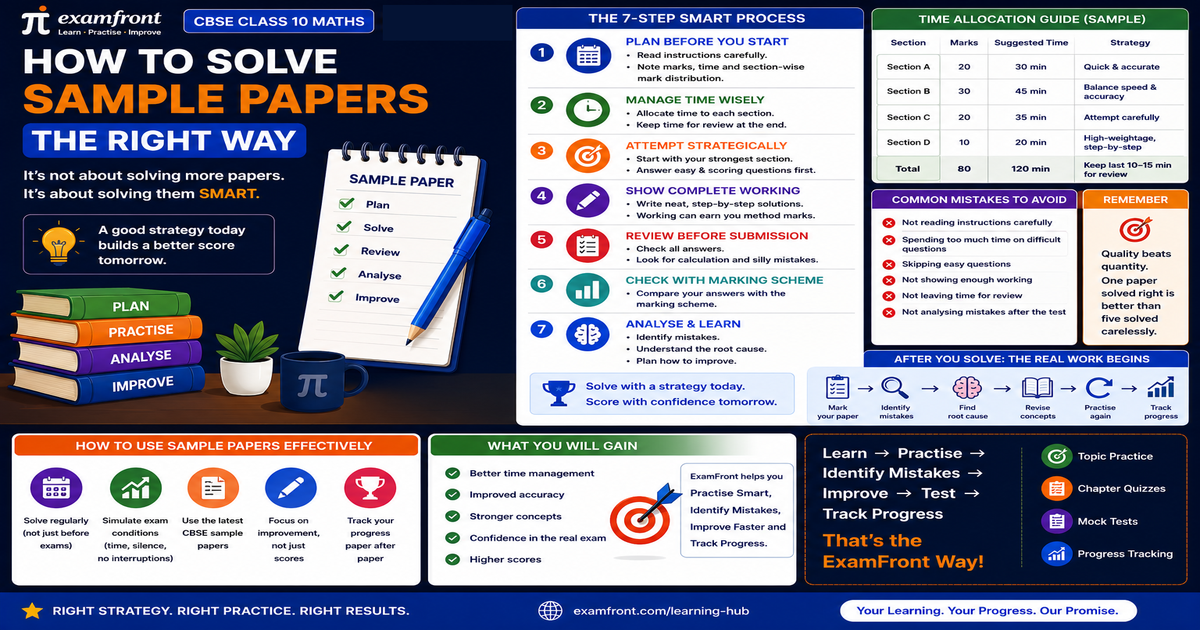
Knowing the maths is only half the battle — this is how to actually attempt a full paper to score your best in the three hours.
You can know every chapter and still lose marks in the exam — not because you didn’t understand the maths, but because you didn’t attempt the paper well. Solving a Class 10 Maths sample paper is a skill of its own: how you use the reading time, what order you tackle questions in, how you manage three hours, and how you handle the questions that stump you. This guide gives you a clear, repeatable strategy for attempting any full paper — the exact thing to practise every time you sit a sample paper.
(This is a deep dive on the Attempt step of the Sample Paper Cycle — the craft of working the paper itself. Once you’ve attempted it, the reviewing and mistake-analysis steps take over.)
The attempt sequence
Before you write: use the 15 minutes of reading time
CBSE provides 15 minutes of reading time before the examination begins. Most students waste it — they read passively or just wait. Used well, it’s one of your biggest advantages. In those 15 minutes:
Scan the whole paper first. Get a feel for its shape — the objective questions in Section A, the answer questions building through B, C and D, the case studies in E. You already know the structure, so this is about this specific paper.
Spot the questions you can do immediately. Mentally tag the ones you’re confident about — those are your secure marks, and knowing where they are settles your nerves.
Note the ones that need thought. Flag the questions you’ll need to come back to, so nothing surprises you once the clock starts.
By the time writing begins, you should have a rough plan — not a rigid one, but a map.
The smart order to attempt
You don’t have to answer questions strictly 1 to 38. A smarter approach protects your marks and your confidence:
Secure the marks you’re sure of first. Start with the questions — objective or otherwise — that you can do quickly and confidently. Banking these early guarantees them, and builds momentum for the harder ones.
Then work through the sections methodically. Move through the paper in a sensible flow, giving the higher-mark questions in Sections D and E the time they deserve.
Leave the ones that need most thought for a considered pass — but don’t skip them entirely; come back with a clear head once your sure marks are banked.
The principle: never let a hard early question eat the time that easy later marks needed.
Managing the three hours
Time is the resource students most often mismanage. You don’t need a rigid minute-by-minute plan, but you do need a sense of proportion:
Match your time to the marks. A 1-mark MCQ shouldn’t get the time a 5-mark long-answer needs. If you find yourself spending several minutes on a single objective question, that’s a signal to mark your best answer and move on.
Keep a rough eye on your pace by section. Roughly speaking, you want to be through the objective and shorter questions efficiently enough to leave solid time for Sections D and E, plus a buffer at the end.
Protect a checking buffer. Aim to finish the paper with time to spare — even ten minutes to review is worth a couple of marks you’d otherwise lose to careless slips.
Where NCERT and CBSE fit into solving a sample paper
A sample paper is not a free-form test. It is built to a published design, and knowing that design turns a vague “manage your time” into an actual plan you can rehearse.
CBSE sets the shape of the paper. The Class 10 Maths paper is 38 questions, 80 marks, three hours, in five sections, with internal choices in Sections B, C, D and E and no overall choice. That fixes how much of your three hours each section deserves — spend it in proportion to the marks, and hold back a quarter of an hour to check:
| Section | Questions | Marks each | Section marks | Time to plan for |
|---|---|---|---|---|
| A | 20 | 1 | 20 | 41 min |
| B | 5 | 2 | 10 | 21 min |
| C | 6 | 3 | 18 | 37 min |
| D | 4 | 5 | 20 | 41 min |
| E | 3 | 4 | 12 | 25 min |
| Total | 38 | — | 80 | 165 min + 15 to check |
Three hours is 180 minutes, and 165 of them divided across 80 marks is a shade over two minutes a mark. If a time plan you’re handed shows four sections, or a two-hour paper, it isn’t describing this exam — check it against the official exam pattern and the question formats before you build a habit on it.
NCERT sets what can be asked. The course is seven units and fourteen chapters, and Constructions is no longer part of it. Nothing on a genuine sample paper sits outside that scope — which is the most reassuring fact in this whole guide. A question you can’t do is not new maths; it is maths you have met, asked in an unfamiliar way. When a sample paper catches you out, the fix is usually a return to the NCERT text and its exercises, not a new book. If you’re not sure how to work the textbook properly, start with how to study NCERT maths and the chapter list.
CBSE sets weightage by unit, not by chapter. Algebra 20, Geometry 15, Trigonometry 12, Statistics & Probability 11, Mensuration 10, Number Systems 6, Coordinate Geometry 6 — 80 marks in total. Chapter-level percentages circulating online are unofficial estimates, so plan your attempt around unit weightage, not around someone’s guess at how many marks Circles is “worth”.
And the paper is not uniformly hard. By CBSE’s own design, 43 of the 80 marks test Remembering and Understanding, 19 test Applying, and 18 test Analysing, Evaluating and Creating. Most of the paper rewards a clean, complete attempt at material you already know — which is exactly why the strategy in this guide beats extra cleverness.
When you sit down with the latest sample paper, you already know its shape before you open it. That is the advantage.
When you get stuck
Every paper has a question that stops you. What separates a strong attempt is how you handle it:
Mark it and move on. Don’t pour ten minutes into one question while easier marks wait. Leave a clear space, move forward, and return with fresh eyes — often the answer comes once you’re relaxed again.
Use the internal choices. CBSE gives internal choices in Sections B, C, D and E. If a question doesn’t suit you, check whether its alternative does — that’s exactly what the choice is for.
Never leave a blank. There’s no negative marking. Even if you’re unsure, attempt something — a partial method can earn partial marks, and an empty answer earns nothing.
Protect your method marks
This is where students quietly lose easy marks. On the subjective questions (Sections B, C, D and the case studies), examiners award marks for your method, not just the final answer.
Show every step. Write your working clearly and in order. Even if you slip at the last step, the method marks are yours.
Present neatly. A clear, logically laid-out solution is easier to award marks to than a cramped one where the examiner can’t follow your reasoning. The marking scheme rewards shown working — so make your working easy to reward.
Leave time to check
The final review pass is one of the highest-value habits you can build. With even a few minutes at the end:
- Check you’ve attempted every question (no accidental skips).
- Re-read the questions you were unsure of.
- Do a quick sanity check on your answers — does each result make sense? An area that came out negative, a probability above 1, a wildly large distance: these are catchable errors.
After the paper: where the real learning happens
Attempting the paper well is step one — but the marks you gain over time come from what you do after. Once you’ve attempted a sample paper, review it honestly against the marking scheme and, crucially, categorise your mistakes so you know exactly what to fix. That’s the step most students skip, and it’s covered in full in our guide to analysing your sample paper mistakes.
This is exactly where examfront amplifies your practice: it lets you attempt papers under real timed conditions, then shows you precisely where your marks leaked and why — the careless slips, the time pressure, the recurring weak spots — so each paper you attempt makes the next one stronger. Practise sample papers with examfront and turn good attempts into rising scores.
Download the 2-page summary (PDF) — the attempt sequence, the section-by-section time plan and a fully worked 5-mark answer, on two printable pages.
Frequently asked questions
How should I attempt a Class 10 Maths sample paper? Use the 15 minutes of reading time to scan the paper and spot your secure questions, attempt the marks you’re confident about first, manage your time by the marks each question carries, mark-and-move-on when stuck, show full working for method marks, and leave time to check at the end.
In what order should I solve the maths paper? You don’t have to go strictly in order. Secure the questions you’re confident about first to bank those marks and build momentum, then work through the rest methodically, giving the higher-mark questions enough time.
Should I leave a question blank if I can’t solve it? No — there’s no negative marking. Attempt something, since partial working can earn partial marks, and check whether an internal choice suits you better.
How much time should I spend on each section? Match time to marks — spend little on 1-mark questions and reserve more for the 5-mark and case-based questions. Aim to finish with a few minutes spare to check your paper.
Are CBSE Class 10 Maths sample papers based on the NCERT syllabus? Yes. The paper is set on the NCERT Class 10 Maths course — seven units and fourteen chapters, with Constructions no longer part of the syllabus — so nothing on a genuine sample paper is outside the textbook you already own. CBSE then fixes the shape: 38 questions, 80 marks, three hours and five sections A to E.
Attempt smarter, score higher. Practise with examfront →