What the Applications of Trigonometry chapter covers, how CBSE tests it, the mistakes to avoid, and how to turn it into strong marks.
Applications of Trigonometry — the “heights and distances” chapter — is where the ratios you learned in Introduction to Trigonometry meet the real world. It’s a satisfying, reliably-tested chapter: the maths is familiar trigonometry, and the challenge is mostly in setting the problem up correctly. Get the diagram right and the marks follow. This guide orients you on what it covers, how it’s tested, the traps, and how to master it.
Chapter snapshot
| Unit | Trigonometry |
| Official unit weightage | 12 marks (CBSE assigns marks per unit, not per chapter) |
| Difficulty | Moderate ⭐⭐⭐☆☆ |
| Practice priority | High (reliably tested, application-focused) |
| Prerequisites | Introduction to Trigonometry (ratios, standard angles) |
| Estimated study time | 2–3 focused sessions |
(Difficulty and study time are a preparation guide, not official CBSE figures.)
What this chapter covers
This chapter applies trigonometric ratios to real situations:
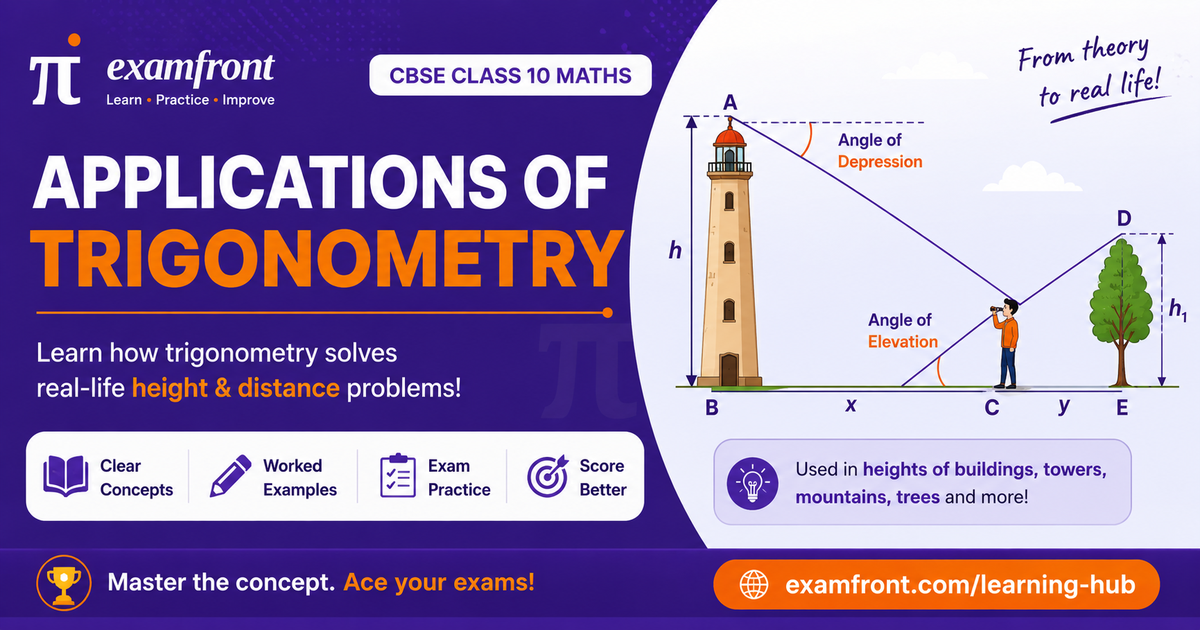
- Angle of elevation — the angle looking up to an object above you.
- Angle of depression — the angle looking down to an object below you.
- Heights and distances — using the ratios to find unknown heights, distances, and lengths in real-world setups (towers, buildings, and so on).
- Multi-step problems — situations involving more than one triangle or observation point.
There are no new ratios here — it’s the application of what you already know, so the skill is in the setup. If the two angles still feel interchangeable, start with the angle of elevation and angle of depression explainer before you attempt full problems.
Why this chapter matters
This chapter is where trigonometry becomes genuinely useful — and where a favourite CBSE question type lives:
Trig ratios → heights & distances → real-world & case-study problems
Heights-and-distances problems appear often, including as case-study questions, so this chapter earns reliable marks — and it cements the trigonometry that carries into senior maths and physics.
How much is Applications of Trigonometry worth?
This chapter is part of the Trigonometry unit, worth 12 marks (see the unit-wise weightage guide). CBSE assigns weightage by unit, not by individual chapter, so it contributes to that 12-mark total alongside Introduction to Trigonometry. As a frequent source of application and case-study questions, it’s a high-priority target.
How CBSE tests Applications of Trigonometry
The board tests the same core skills in familiar formats:
| Common question type | Skill tested |
|---|---|
| Find a height using elevation | Application |
| Find a distance using depression | Application |
| Multi-triangle heights problem | Reasoning |
| Case-study heights-and-distances problem | Application |
These appear as short-answer, long-answer, and case-study questions. The wording and context change yearly while the skills repeat (the idea behind analysing previous year questions).
Common mistakes in Applications of Trigonometry
A few classic traps cost students marks here:
- Drawing the diagram wrong — the single biggest cause of lost marks; a wrong diagram derails everything.
- Confusing elevation and depression — placing the angle in the wrong position.
- Choosing the wrong ratio — using tan where sin or cos is needed for the given sides.
- Skipping the diagram entirely — trying to solve from the words alone.
Most of these are question-reading and method mistakes at the setup stage — exactly the kind the examfront Mistake Framework helps you catch and fix.
Skills you’ll build
Master this chapter and you’ll be able to:
- ✓ Draw an accurate diagram from a worded problem
- ✓ Correctly place angles of elevation and depression
- ✓ Choose the right trigonometric ratio for the situation
- ✓ Solve multi-step heights-and-distances problems
Your roadmap to full marks
Understanding this chapter is quick — it’s trigonometry you already know. Mastering it comes from practising the setup: turning a worded situation into a correct diagram, placing the angle, and picking the right ratio. That translation skill only comes from doing many varied problems.
That’s where examfront turns understanding into marks. You get targeted, chapter-wise adaptive practice on elevation, depression, and multi-step heights-and-distances problems — with instant feedback that pinpoints exactly where you slip (a wrong diagram? the wrong ratio?) so you fix it fast. The adaptive practice serves the right questions at the right level, and mistake-tracking reveals your patterns. Practise Applications of Trigonometry on examfront and turn this chapter into reliable marks.
Before moving on
Before you move to the next chapter, make sure you can:
- ✓ Draw a correct diagram from a worded problem
- ✓ Tell an angle of elevation from an angle of depression
- ✓ Choose the right ratio for the given sides
- ✓ Solve a multi-step heights-and-distances problem
Download the 2-page summary
📄 Download the Applications of Trigonometry 2-page summary (PDF) — definitions, the core ratios, a worked example, and the mistakes to avoid, on one printable sheet.
Continue your journey
← Previous: Introduction to Trigonometry · Next: Circles →
Or browse the full chapter list to plan your path.
Frequently asked questions
Is Applications of Trigonometry an important chapter in Class 10 Maths? Yes — it’s part of the Trigonometry unit (12 marks), and heights-and-distances problems are tested reliably, often as case-study or long-answer questions. It’s a high-value, scoreable chapter.
What are the main topics in Applications of Trigonometry Class 10? Angles of elevation and depression, and using trigonometric ratios to solve real-world heights-and-distances problems involving towers, buildings, and similar situations.
Why do students lose marks in Applications of Trigonometry? Usually through drawing the diagram incorrectly, confusing angles of elevation and depression, or choosing the wrong ratio — the setup is where most marks are lost.
How do I get full marks in Applications of Trigonometry? Always draw a clear, correct diagram first, identify the angle and the right ratio, and show complete working. Strong Introduction to Trigonometry fundamentals make this chapter much easier.
Turn Applications of Trigonometry into strong marks. Practise on examfront →