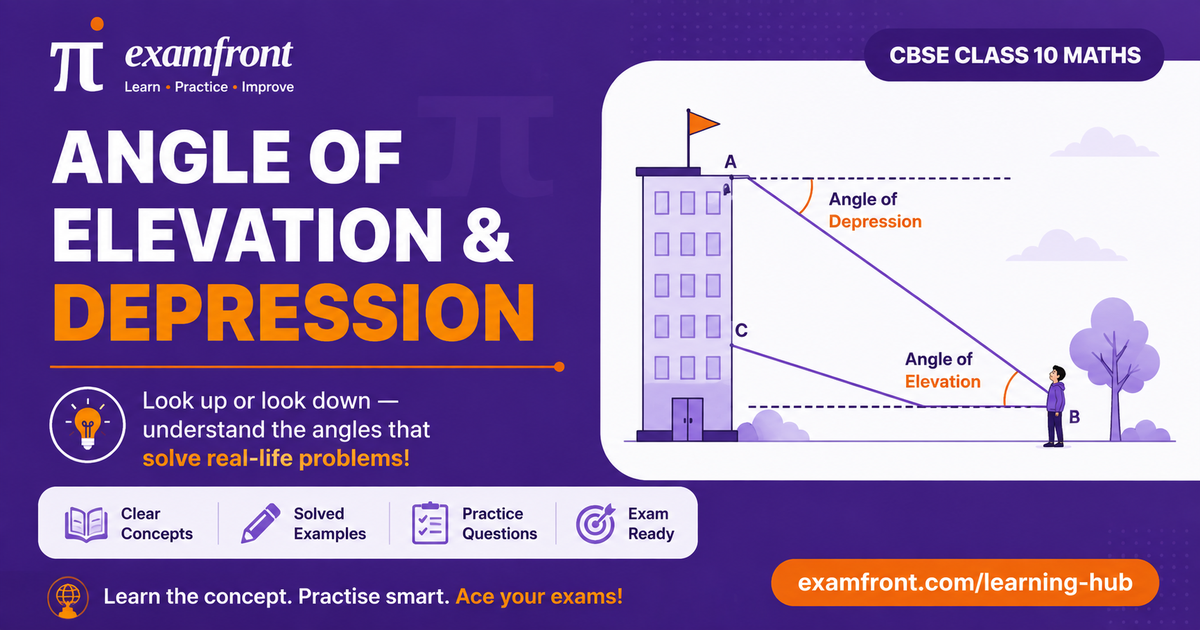
Angle of Elevation and Angle of Depression (Class 10)
In one line: the angle of elevation is the angle your line of sight makes with the horizontal when you look up at an object, and the angle of depression is the angle it makes with the horizontal when you look down at an object.
Both angles are measured from the same reference — the horizontal line through the observer’s eye. The only difference is direction: for an object above eye level you raise your head, giving an angle of elevation; for an object below eye level you lower your head, giving an angle of depression. Nothing else changes — the object being higher or lower is what decides which name applies.
These two ideas are the foundation of the whole chapter Some Applications of Trigonometry. Once you can correctly spot the line of sight and mark the right angle in a figure, solving for an unknown height or distance is just choosing a trigonometric ratio (usually tan θ). This guide defines each term precisely, shows the difference in a table, explains the important equal-angle rule, and works through simple examples. To actually calculate heights and distances step by step, pair this with our Heights and Distances (Class 10) guide.
What is the line of sight?
The line of sight is the straight line drawn from the eye of an observer to the point on the object being viewed. Every elevation or depression problem starts here: you first draw the line of sight, then measure the angle it makes with the horizontal.
The horizontal line is the flat, ground-parallel line through the observer’s eye. It is the reference from which both angles are measured. Keep these two terms distinct throughout: the line of sight points at the object, while the horizontal line is the level baseline.
🎬 Watch — 30-sec Short: Can you spot the correct reference line? 👀
What is the angle of elevation?
The angle of elevation of a point is the angle formed by the line of sight with the horizontal when the point being viewed is above the horizontal level — the case where you raise your head to look at the object.
For example, imagine standing some distance from a tall minar and looking at its top. The line from your eye to the top of the minar is the line of sight, and the angle between that line and the horizontal ground direction is the angle of elevation of the top of the minar.
Worked example (elevation): A point on the ground is 20 m from the foot of a tower. The angle of elevation of the top of the tower from this point is 30°. How tall is the tower?
- The tower is vertical, the ground is horizontal, so we have a right-angled triangle.
- The height is the opposite side to the 30° angle; the 20 m ground distance is the adjacent side.
- Use tan because it links opposite and adjacent: tan 30° = height ÷ 20.
- So height = 20 × tan 30° = 20 × (1/√3) ≈ 11.55 m.
That single decision — “opposite and adjacent, so use tan” — is the move you will make again and again. You can drill dozens of these quickly with examfront’s Topic Practice so the ratio choice becomes automatic.
What is the angle of depression?
The angle of depression of a point is the angle formed by the line of sight with the horizontal when the point being viewed is below the horizontal level — the case where you lower your head to look at the object.
For example, imagine sitting on a balcony and looking down at a flower pot on the steps below. The line from your eye down to the pot is the line of sight, and the angle between that line and the horizontal is the angle of depression of the pot.
🎬 Watch — 30-sec Short: Can you spot the angle of depression? 👀
The equal-angle rule: elevation = depression
Here is the single most useful fact in this topic. For the same two points, the angle of depression from the top equals the angle of elevation from the bottom.
Why? The observer’s horizontal line at the top and the ground level at the bottom are parallel lines. The line of sight joining the two points is a transversal cutting both. The angle of depression (at the top) and the angle of elevation (at the bottom) are therefore alternate interior angles, which are always equal.
This rule matters because the angle of depression is given “up high,” but the right triangle you want to solve is usually “down low.” The rule lets you copy the given angle down into the ground-level triangle and solve normally.
Worked example (depression): From the top of a 30 m tall building, the angle of depression of a car parked on the road is 30°. How far is the car from the base of the building?
- By the equal-angle rule, the angle of elevation of the building’s top from the car is also 30°.
- In the right triangle, the 30 m height is opposite the 30° angle and the distance d is adjacent.
- tan 30° = 30 ÷ d, so d = 30 ÷ tan 30° = 30√3 ≈ 51.96 m.
If marking the angle in the correct triangle is where you slip, the Mistake Identification tool on examfront flags exactly that kind of set-up error as you practise.
🎬 Watch — 30-sec Short: Can you spot the link between elevation and depression? 👀
Elevation vs depression — quick comparison
Keep the two straight with this table. Notice that the method is identical; only the object’s position and your head movement change.
| Feature | Angle of elevation | Angle of depression |
|---|---|---|
| Object is… | above eye level | below eye level |
| You… | raise your head | lower your head |
| Measured from | the horizontal | the horizontal |
| Line of sight goes | upward to the object | downward to the object |
| Common set-up | observer on ground looks at a top | observer on a height looks at a point below |
A helpful check: the words describe your line of sight, not the object. Looking up is always elevation; looking down is always depression — regardless of how tall the object itself is.
How these angles are used in the chapter
In Some Applications of Trigonometry, every problem gives you two of three things — a distance, an angle (of elevation or depression), and a height — and asks for the third. You draw the figure, mark the correct angle (using the equal-angle rule for depression), identify the right triangle, and pick a trigonometric ratio. Because the unknown is usually a height (opposite) with a known base distance (adjacent), tan θ is the most common choice; sin or cos appear when a slant length such as a ladder or rope (the hypotenuse) is involved.
We have kept the harder multi-triangle set-ups — two observers, moving objects, and problems that combine an elevation and a depression — light here. You can learn those extensively and get personalised help where you slip inside examfront. The full calculation method, with more worked cases, is in Heights and Distances (Class 10).
Key Takeaways
- The line of sight goes from the observer’s eye to the object; both angles are measured from the horizontal through the eye.
- Angle of elevation = looking up at an object above eye level.
- Angle of depression = looking down at an object below eye level.
- Equal-angle rule: for the same two points, the angle of depression from the top equals the angle of elevation from the bottom (alternate interior angles).
- The method is the same for both — draw the figure, mark the angle, choose a ratio (usually tan θ = opposite/adjacent).
Quick Facts
- Line of sight: straight line from the observer’s eye to the point viewed.
- Angle of elevation: angle of the line of sight above the horizontal (looking up).
- Angle of depression: angle of the line of sight below the horizontal (looking down).
- Reference line for both: the horizontal through the observer’s eye.
- Key rule: angle of depression = angle of elevation for the same two points.
- Most-used ratio: tan θ = opposite ÷ adjacent = height ÷ horizontal distance.
- Chapter: Some Applications of Trigonometry · Class: 10 · Subject: Maths · Board: CBSE.
Common Mistakes
- Measuring the angle from the object instead of the observer. The angle is always at the observer’s eye, between the horizontal and the line of sight — not at the top of the tower.
- Forgetting the equal-angle rule for depression. Students leave the depression angle “up top” and cannot form a triangle. Copy it down as the equal angle of elevation at the bottom.
- Swapping elevation and depression. Looking up is elevation, looking down is depression — decided by the object’s position relative to the eye, not by its size.
- Choosing the wrong ratio. When both a height (opposite) and a base distance (adjacent) are involved, use tan, not sin or cos.
- Ignoring the observer’s own height. If the observer’s eye is above the ground, the height you compute is measured from eye level and the observer’s height must be added back.
Download the 2-page summary
Want the definitions, the equal-angle rule and a fully worked example on one printable sheet? ⬇ Download the Angle of Elevation & Depression summary (PDF) — keep it in your revision folder for the night before the exam.
FAQ
Q. What is the angle of elevation in Class 10 Maths? It is the angle formed by the line of sight with the horizontal when you look up at an object above your eye level — for instance, looking from the ground at the top of a tower.
Q. What is the angle of depression? It is the angle formed by the line of sight with the horizontal when you look down at an object below your eye level — for instance, looking from a rooftop at a car on the road.
Q. What is the difference between angle of elevation and angle of depression? Both are measured from the horizontal. Elevation is measured upward (object above you); depression is measured downward (object below you). Which one applies depends only on whether the object is above or below the observer’s eye.
Q. Why is the angle of depression equal to the angle of elevation? Because the observer’s horizontal line and the ground are parallel, and the line of sight is a transversal. The two angles are alternate interior angles, so they are equal — letting you move the angle into the ground-level right triangle.
Q. Is the angle of elevation measured from the ground or from the object? It is measured at the observer’s eye, from the horizontal up to the line of sight. In most Class 10 problems the observer is treated as a point on the ground, so it is effectively from ground level to the top of the object.
Related Concepts
- Heights and Distances (Class 10): the calculation method that uses these angles to find real heights and distances.
- Applications of Trigonometry — Chapter Guide: the full Chapter 9 roadmap and where this topic fits.
- Introduction to Trigonometry (Class 10): the trigonometric ratios (sin, cos, tan) these problems rely on.
- Triangles (Class 10): right-triangle basics and the alternate-angles property behind the equal-angle rule.
Ready to turn these angles into answers? Practise a full set of elevation and depression problems on examfront’s Topic Practice, and let the Practice Companion and Mistake Identification catch your set-up slips. Start on examfront →