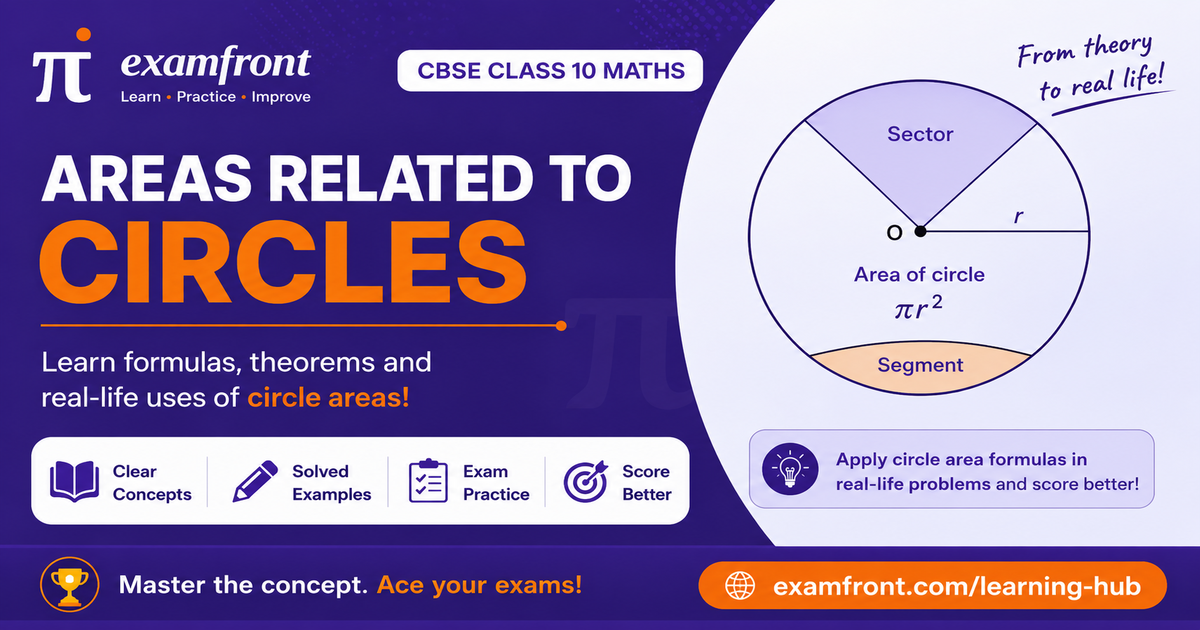
What the Areas Related to Circles chapter covers, how CBSE tests it, the mistakes to avoid, and how to turn it into strong marks.
Areas Related to Circles is a formula-driven chapter in the Mensuration unit — it’s about finding the areas of sectors, segments, and combinations of figures involving circles. Like most mensuration topics, it rewards knowing the formulas precisely and applying them carefully. This guide orients you on what it covers, how it’s tested, the traps, and how to master it.
Chapter snapshot
| Unit | Mensuration |
| Official unit weightage | 10 marks (CBSE assigns marks per unit, not per chapter) |
| Difficulty | Moderate ⭐⭐⭐☆☆ |
| Practice priority | High (formula-driven, reliable marks) |
| Prerequisites | Area and circumference of a circle, angles, basic arithmetic |
| Estimated study time | 2–3 focused sessions |
(Difficulty and study time are a preparation guide, not official CBSE figures.)
What this chapter covers
The chapter builds on the circle you already know:
- Area and circumference — the base results for a full circle.
- Area of a sector — the “slice” of a circle bounded by two radii and an arc.
- Area of a segment — the region between a chord and its arc.
- Combinations of figures — areas of shapes made by combining circles with triangles, squares, and other figures.
A handful of formulas, applied with care, carry the chapter — which is what makes it reliably scoreable.
Why this chapter matters
This chapter builds the careful, formula-precise working that all of mensuration rewards:
Circle areas → sectors & segments → combination-figure problems
The discipline of picking the right formula and computing cleanly (especially with π and angles) is exactly what the Surface Areas and Volumes chapter demands next. Mensuration carries 10 marks, so precision here pays off directly.
How much is Areas Related to Circles worth?
This chapter is part of the Mensuration unit, worth 10 marks (see the unit-wise weightage guide). CBSE assigns weightage by unit, not by individual chapter, so it contributes to that 10-mark total alongside Surface Areas and Volumes. As a reliable source of sector-and-segment questions, it’s a solid priority for marks.
How CBSE tests Areas Related to Circles
The board tests the same core skills in familiar formats:
| Common question type | Skill tested |
|---|---|
| Find the area of a sector | Procedure |
| Find the area of a segment | Procedure |
| Combination-of-figures area | Application |
| Perimeter/area with an arc | Application |
These appear as MCQs, short-answer, and long-answer questions. The wording changes yearly while the skills repeat (the idea behind analysing previous year questions).
Common mistakes in Areas Related to Circles
A few classic traps cost students marks here:
- Wrong formula — confusing the sector and segment formulas.
- Angle errors — using the wrong angle, or mishandling the fraction of the circle.
- π and unit slips — inconsistent use of π, or mixing up units.
- Combination-figure errors — adding when you should subtract areas, or vice versa.
Most are calculation and method mistakes — exactly the kind the examfront Mistake Framework helps you catch and fix.
Skills you’ll build
Master this chapter and you’ll be able to:
- ✓ Find the area of a sector and a segment accurately
- ✓ Work with arc length and the angle at the centre
- ✓ Solve combination-of-figures area problems
- ✓ Handle π and units cleanly
Your roadmap to full marks
Understanding this chapter is quick — it’s a set of formulas. Mastering it means applying them precisely: the right formula, the right angle, clean arithmetic, and careful handling of combination figures.
That’s where examfront turns understanding into marks. You get targeted, chapter-wise adaptive practice on sectors, segments, and combination figures — with instant feedback that pinpoints exactly where you slip (wrong formula? an angle error?) so you fix it fast. The adaptive practice serves the right questions at the right level, and mistake-tracking reveals your patterns. Practise Areas Related to Circles on examfront and lock in these marks.
Before moving on
Before you move to the next chapter, make sure you can:
- ✓ Find the area of a sector and a segment
- ✓ Use the central angle correctly
- ✓ Solve a combination-of-figures problem
- ✓ Handle π and units without slips
Continue your journey
← Previous: Circles · Next: Surface Areas and Volumes →
Or browse the full chapter list to plan your path.
📥 Download the free 2-page Areas Related to Circles summary PDF — formulas, key takeaways and a worked example to revise from.
Frequently asked questions
Is Areas Related to Circles an important chapter in Class 10 Maths? Yes — it’s part of the Mensuration unit (10 marks), and sector and segment area problems are tested reliably. It’s a formula-driven, scoreable chapter.
What are the main topics in Areas Related to Circles Class 10? Area and circumference of a circle, area of a sector, area of a segment, and areas of combinations of plane figures involving circles.
Why do students lose marks in Areas Related to Circles? Usually through using the wrong formula for a sector or segment, angle or unit errors, or calculation slips with π — avoidable with careful practice.
How do I get full marks in Areas Related to Circles? Know the sector and segment formulas precisely, be careful with the angle and units, and practise combination-figure problems — showing complete working.
Turn Areas Related to Circles into strong marks. Practise on examfront →