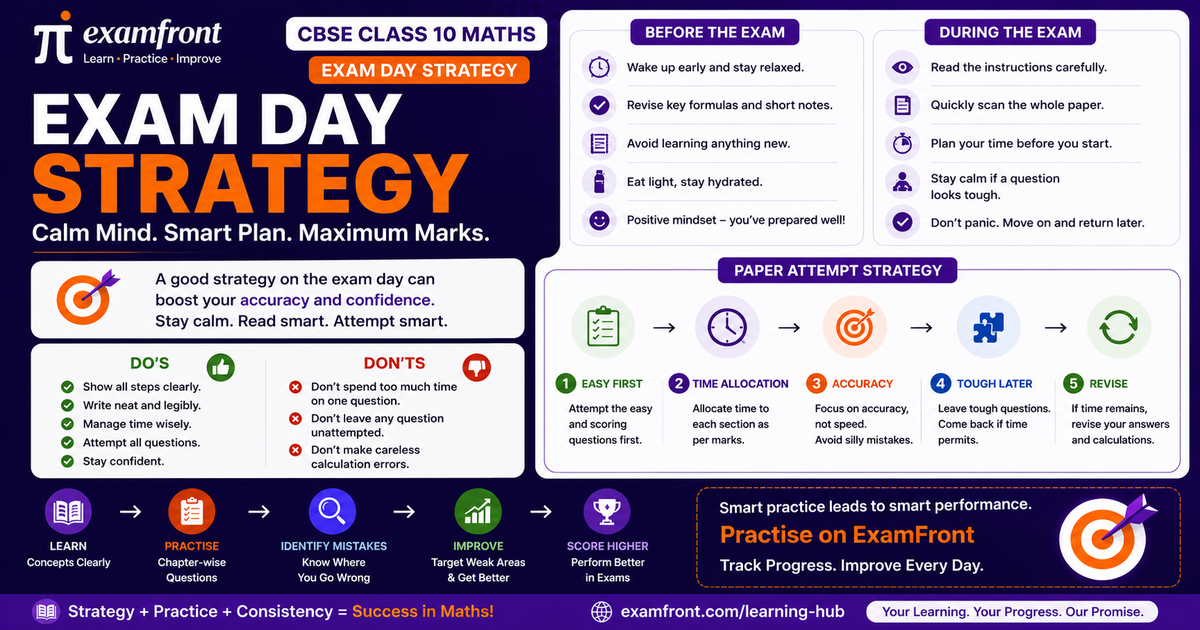
Preparation gets you to the exam ready — a good exam-day plan makes sure you actually deliver it. Here’s how to handle the whole day, from the night before to the final check.
You’ve done the work. Exam day is about delivering it — and a surprising number of marks are won or lost not on knowledge, but on how you handle the day itself: your sleep, your calm, your timing, your composure under pressure. This guide gives you a complete exam day strategy for Class 10 Maths, so nothing on the day trips you up.
What you’re walking into: the CBSE and NCERT paper
A calm exam day starts with knowing exactly what’s coming. The CBSE Class 10 Mathematics paper is 3 hours, 80 marks, 38 questions, split across five sections — and there’s no overall choice, though some questions carry an internal choice:
| Section | Questions | Marks each | Total |
|---|---|---|---|
| A | 20 (18 MCQ + 2 assertion–reason) | 1 | 20 |
| B | 5 | 2 | 10 |
| C | 6 | 3 | 18 |
| D | 4 | 5 | 20 |
| E | 3 case-based | 4 | 12 |
That’s the shape of the paper you’ll open — our CBSE exam pattern guide breaks each section down in detail.
The second thing worth knowing on the morning: every question is set on the rationalised NCERT syllabus. Nothing outside your NCERT textbook can appear. That has one practical exam-day consequence — your final revision should be NCERT formulas, NCERT examples and past CBSE papers, never a new book or a friend’s notes picked up outside the exam hall. If you’ve been studying from NCERT properly all year, you’ve already seen every question type the paper can ask; the NCERT Class 10 Maths guide shows how the textbook maps onto the board paper.
The night before
The night before sets up your whole exam. The goal is calm and rest, not last-minute cramming:
- Do light revision only — quick recall of formulas and key methods, not new topics. Trying to learn something new now just raises anxiety. (A last-week revision plan helps you pace this.)
- Pack everything tonight — admit card, ID, and all your stationery — so the morning is stress-free.
- Sleep properly. A rested brain solves problems faster and makes fewer careless errors than a tired, crammed one. Sleep is genuinely part of your preparation.
What to bring
Prepare this the night before, and check it in the morning:
- Admit card (and ID if your centre requires it)
- Pens (spares), pencils, eraser, sharpener
- Ruler and a geometry box — maths papers often need clean diagrams
- A watch if allowed, to keep track of time
Having everything ready removes a whole category of morning panic.
The morning and arriving
- Eat a proper, familiar breakfast — enough to stay focused through a three-hour paper, nothing unusual that might unsettle you.
- Leave early. Rushing or worrying about being late spikes your stress before you’ve even sat down. Arriving with time to spare lets you settle.
- Once there, avoid last-minute panic discussions with classmates about what they revised — it rarely helps and often unsettles you. Stay in your own calm.
Using the reading time
CBSE gives you 15 minutes of reading time before writing begins — use it well. Scan the whole paper, spot the questions you can do confidently, and note the ones to come back to. You walk into the writing phase with a plan instead of a surprise. (Our guide on how to solve a sample paper covers this attempt strategy in full — it’s exactly what to apply on the day.)
Managing the paper
The in-exam approach that protects your marks:
- Secure your sure marks first. Start with the questions you’re confident about — banking them builds momentum and calms your nerves.
- Match time to marks. Don’t pour minutes into a 1-mark question; move on and return.
- Mark-and-move when stuck. A hard question is just one question. Leave it, keep going, come back with a clearer head.
- Show your working. Method marks are real marks — write your steps clearly.
- Never leave blanks — there’s no negative marking, so always attempt something.
Staying calm under pressure
Nerves are normal — the trick is not letting them take over:
- If you feel panic rising, pause and take a few slow breaths. It genuinely resets your focus.
- Return to something you can do. A few secured marks settle your mind faster than anything.
- Keep perspective: one tricky question is not the whole paper. Students routinely feel a wobble mid-exam and still finish strongly.
Leave time to check
Aim to finish with a few minutes to spare, and use them:
- Confirm you’ve attempted every question — no accidental skips.
- Re-read the ones you were unsure about.
- Do a quick sanity check — a negative area or a probability above 1 is a catchable error.
A calm final pass often rescues a couple of marks you’d otherwise lose to a careless slip.
Preparation is what makes the day calm
The single best way to stay calm on exam day is to arrive genuinely prepared — confidence comes from knowing you’ve done the work. That’s what a full study plan and steady practice build. examfront helps you get there: by the time exam day comes, you’ve practised under realistic conditions, know your strengths, and have fixed your weak spots — so you walk in ready to deliver. Prepare with examfront and make exam day the easy part.
📄 Download the 2-page exam day summary (PDF) — the timeline, the paper-attempt order and the section-wise time budget on one printable sheet.
Frequently asked questions
What should I do the night before my Class 10 Maths exam? Do light revision only — quick recall of formulas and key methods, not new topics. Pack everything you need, and prioritise a good night’s sleep. Being rested helps far more than late cramming.
What should I carry to the maths exam? Your admit card, ID if required, and your allowed stationery — pens, pencils, eraser, sharpener, ruler, and a geometry box. Prepare it all the night before so the morning is calm.
How do I stay calm during the maths exam? Use the reading time to plan, start with questions you’re confident about to build momentum, breathe slowly if you feel panic, and remember that one hard question is just one question — move on and come back.
What should I do if I panic during the exam? Pause, take a few slow breaths, and return to a question you can do. Banking a few marks you’re sure of settles your nerves. A single tricky question is not the whole paper.
Is the CBSE Class 10 Maths board paper based on NCERT? Yes. CBSE sets the paper on the rationalised NCERT syllabus, so every question comes from material in your NCERT textbook. On exam day that means your last revision should be NCERT formulas, NCERT examples and past CBSE papers — not a new book or a friend’s notes.
Walk in prepared, walk out confident. Prepare with examfront →