The one question type students misjudge most — decoded. Understand the four options and you’ll get these marks every time.
If assertion-reason questions leave you second-guessing, you’re far from alone — they’re the format students misjudge most often in the Class 10 Maths paper. But here’s the good news: assertion-reason questions in Class 10 Maths follow a fixed, predictable logic. There’s no maths trickery involved — just a small decision to make correctly. Once you understand what the four options actually mean, these become some of the most reliable marks on the paper.
What are assertion-reason questions?
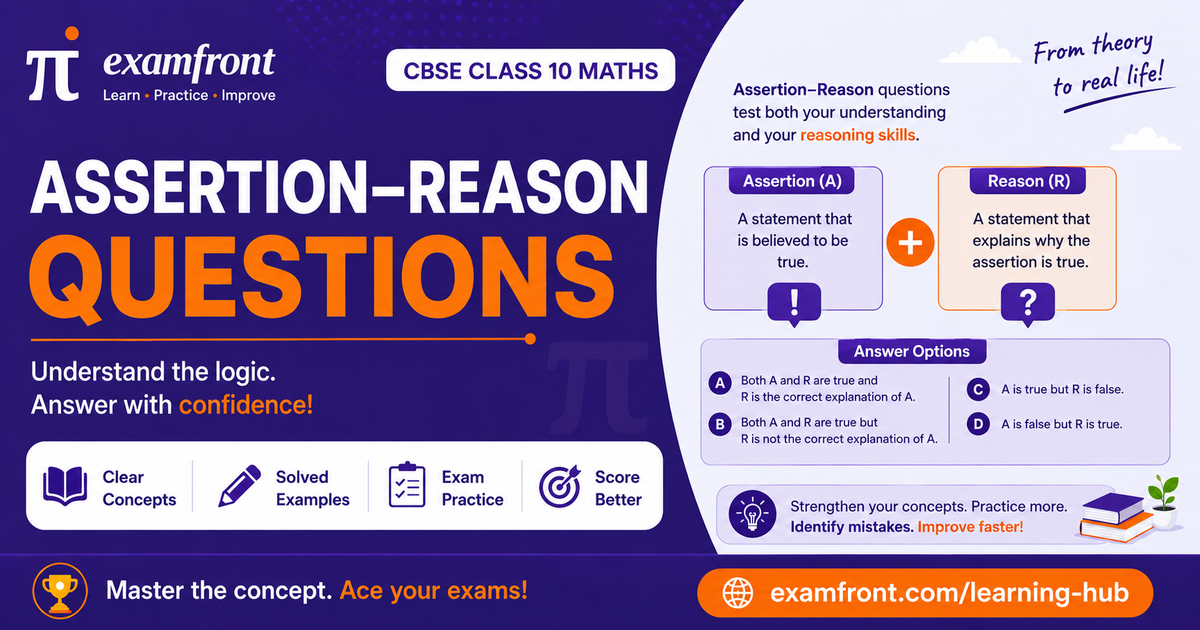
An assertion-reason question gives you two statements:
- an Assertion (A) — a claim
- a Reason (R) — a statement offered as the explanation for that claim
Your job is to judge two things: whether each statement is true, and — crucially — whether the Reason correctly explains the Assertion. You then pick one of four fixed options that matches your judgement.
These appear in Section A of your paper — 2 assertion-reason questions, worth 1 mark each — alongside the MCQs. For where they sit in the full paper, see the exam pattern guide.
The four options — what each one actually means
This is the whole game. The four options are always the same, and understanding exactly what each means is what separates a confident answer from a guess:
- (a) Both A and R are true, and R is the correct explanation of A
- (b) Both A and R are true, but R is not the correct explanation of A
- (c) A is true, but R is false
- (d) A is false, but R is true
Read options (a) and (b) again carefully, because the difference between them is where most marks are lost. In both, both statements are true — the only question is whether R actually explains A. If R is a true statement but has nothing to do with why A is true, the answer is (b), not (a). Students who don’t slow down here pick (a) out of habit and lose the mark.
A step-by-step method to choose the right option
Turn the decision into three simple questions, asked in order, and you’ll never guess again:
Step 1 — Is the Assertion true? Judge statement A on its own.
Step 2 — Is the Reason true? Judge statement R on its own, independently of A.
Step 3 — If both are true, does R actually explain A? This is the deciding step. If R is the reason A is true → option (a). If both are true but R doesn’t explain A → option (b).
And the simpler cases fall out automatically: if A is true but R is false → (c); if A is false but R is true → (d).
Ask these three questions in order, every time, and the right option chooses itself.
The classic trap: “both true but unrelated”
The single most common assertion-reason mistake is picking (a) when the answer is (b). It happens because both statements are true, and in a hurry it feels like they must go together. But “both true” is not the same as “one explains the other.”
Think of it like this: “The sky is blue” and “water boils at 100°C” are both true — but the second doesn’t explain the first. That’s an option (b) situation. In maths, R might state a correct theorem or fact, but if it isn’t the reason A holds, the answer is (b). Always check the explanation link, don’t just check that both are true.
Seeing the method in action
Here’s an illustrative example (constructed to show the method — not a real exam question):
Assertion (A): The number 6 is a composite number. Reason (R): A composite number has more than two factors.
Apply the three questions:
- Is A true? Yes — 6 has factors 1, 2, 3, 6, so it’s composite.
- Is R true? Yes — that’s the correct definition of a composite number.
- Do both hold and does R explain A? Yes — 6 is composite precisely because it has more than two factors. R explains A.
So the answer is option (a). Now imagine R had instead said “2 is a prime number” — a true statement, but nothing to do with why 6 is composite. That would be option (b): both true, no explanation link. Same method, different answer — and you’d get it right by asking the three questions rather than guessing.
Common mistakes to avoid
- Picking (a) whenever both statements are true — always check whether R explains A first.
- Judging R based on A — assess each statement independently before comparing them.
- Rushing — these are quick marks, but the explanation check takes a moment’s thought. Give it that moment.
- Second-guessing a sound judgement — once the three questions point to an option, trust it.
How to get good at assertion-reason questions
Assertion-reason is pure pattern recognition — and patterns become automatic with practice. Work through a few dozen of them applying the three-question method, and you’ll soon read the options almost instinctively. The logic that feels fiddly now becomes second nature surprisingly fast.
That’s exactly the kind of focused, format-specific practice examfront is built for: it drills you on assertion-reason questions until the option logic is automatic, and flags when you fall for the “both true but unrelated” trap. A handful of focused sessions can turn these from a guess into guaranteed marks. Practise assertion-reason with examfront and lock in these marks.
What to read next
- Question types explained — every question format in the paper
- Case study questions — how to solve Section E with confidence
- Exam pattern — the full paper structure
- MCQ questions — the other Section A format, worth 20 marks
Download the 2-page assertion-reason summary PDF — the four options, the three-question method and a worked example on one printable sheet.
Frequently asked questions
What are assertion-reason questions in Class 10 Maths? They give you two statements — an Assertion and a Reason — and ask you to judge whether each is true and whether the Reason correctly explains the Assertion, then pick one of four fixed options. There are 2 such questions in Section A, worth 1 mark each.
What are the four options in assertion-reason questions? (a) Both true and R explains A; (b) both true but R doesn’t explain A; (c) A true, R false; (d) A false, R true.
What is the most common mistake in assertion-reason questions? Choosing option (a) when the answer is (b) — that is, assuming that because both statements are true, R must explain A. Always check the explanation link separately.
How do I get better at assertion-reason questions? Practise using a fixed three-step check: Is A true? Is R true? If both, does R explain A? With a few dozen practised, the logic becomes automatic.
Turn assertion-reason into guaranteed marks. Practise with examfront →